




Specifying natural food colorants works best backwards: start from the shade your product needs, then narrow the candidates by matrix chemistry, process conditions and regulatory identity. This guide follows that order - hue first, constraints second, blending third, then a technical brief you can send to a supplier the same day.
Start from the Target Color, Not the Ingredient List
Ask a supplier what they have and you receive a catalogue; ask what the product requires and you get a shortlist. That difference often decides whether sourcing takes two months or two weeks.
Why the ingredient-first approach stalls
Ingredient-first sourcing treats every botanical source as a candidate, so the comparison drifts toward the most familiar name rather than the most suitable chemistry - and two "purple" powders can sit in entirely different colorant families, with different pH behaviour, solubility and label treatment. Without a target hue and matrix written down first, there is no objective way to choose.
Three constraints that decide feasibility
Three questions eliminate most candidates before a sample is requested:
- Matrix pH. Anthocyanin-based colorants develop their colour in acidic systems; toward neutral or alkaline, the usable range narrows sharply - a near-neutral matrix means a smaller candidate set than a catalogue suggests.
- Process temperature and shelf life. Heat load during processing and light exposure in storage decide which families survive to the end of shelf life, not which look right on day one.
- Regulatory identity. The same botanical material can be classified differently across markets - as a colour additive or as a colouring food - and that classification drives labelling and compliance work. The mechanics are covered in our guide to the regulatory roadmap for switching from synthetic dyes [1][2].
The Color-by-Color Reference: Which Plant Colorant for Which Hue
This reverse index of natural food colorants maps each hue family to the plant sources worth considering and the constraint that most often disqualifies them. Figures are qualitative here - confirm exact numbers against the supplier's TDS for the grade you buy.
Reds and pinks
The widest hue family. Betanin from red beet is heat-sensitive, which limits long-heat processes. Carmine is heat-tolerant, but animal-derived - confirm it against your label and religious-certification requirements before sampling. Anthocyanin extracts give reds to pinks in acidic matrices, with hue shifting as pH moves. Lycopene and capsanthin pigment powder are oil-soluble reds for fat-containing systems or dispersion forms.
Yellows and oranges
Beta-carotene anchors the orange range, usually in beadlet or dispersion form when water dispersibility is needed. Turmeric/curcumin gives an intense yellow but is pH- and light-sensitive and adds flavour. Gardenia yellow is a water-soluble yellow common in Asian beverage and confectionery work; marigold (lutein) is a clean-label option supplied in oil or dispersion form.
Blues, purples and greens
Here natural colors are scarcest, and blending earns its place. Gardenia blue powder is water-soluble and blends with yellows to reach greens. Anthocyanins can be pushed toward violet in higher-pH systems, accepting the stability penalty. Spirulina/phycocyanin delivers a true blue but is heat-sensitive, while chlorophyll and chlorophyllin cover greens - water-soluble and oil-soluble forms are not interchangeable.
Browns and neutral tones
Caramelised and baked sources deliver browns and warm neutrals; their regulatory identity depends on the process used, not only the raw material.
| Target hue | Candidate sources | Colorant family | Main constraints (qualitative) |
|---|---|---|---|
| Red / pink | Red beet (betanin), carmine, anthocyanin extracts, lycopene, capsanthin | Betalain / carminic acid / anthocyanin / carotenoid | Betanin heat-sensitive; carmine animal-derived (check label & certification); anthocyanins need acidic matrices; carotenoids oil-soluble and oxidation/light-sensitive |
| Yellow / orange | Beta-carotene, turmeric (curcumin), gardenia yellow, marigold (lutein) | Carotenoid / curcuminoid | Carotenoids oil-soluble unless supplied as beadlets/dispersions, light-sensitive; curcumin pH- and light-sensitive, adds flavour |
| Blue / purple / green | Gardenia blue, anthocyanin extracts (pH-shifted), spirulina (phycocyanin), chlorophyll / chlorophyllin | Various | Blue sources scarce; phycocyanin heat-sensitive; water-soluble and oil-soluble chlorophyll forms behave differently |
| Brown / neutral | Caramelised and baked/caramelised plant sources | - | Regulatory identity depends on the production process |
Blending to a Target Shade
Most brand colours are not a single hue but a position in colour space that must be hit batch after batch. Blending natural food colorants is how you get there - and how you get into trouble if compatibility questions are skipped.
Same-family vs cross-family blending
Same-family blends (one anthocyanin with another, one carotenoid with another) are the most controllable: components respond similarly to pH and processing, so adjustments are predictable. Cross-family blends reach shades no single family can deliver - purples and greens from blue plus red or yellow - but they add compatibility risk, because the two components may respond differently to the same matrix conditions.
Compatibility traps
- pH conflict. One component may be at its most stable in the range where the other fades; blend proportions and pH must be fixed together, not sequentially.
- Metal ions. Anthocyanins can interact with metal ions in the matrix or from equipment, shifting shade and stability - effects that vary by system and must be tested [3].
- Oxidation. Carotenoids are vulnerable to oxidation, amplified in high-fat systems and by prolonged light exposure.
- Carriers and diluents. Spray-drying carriers change the colour intensity a powder delivers per gram.
- Oil/water incompatibility. Oil-soluble and water-soluble colorants cannot simply be mixed; each must first be brought into a dispersible form.
A practical blending sequence
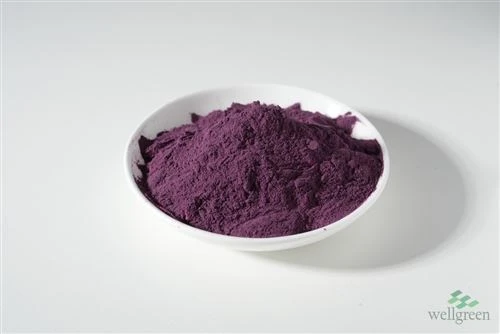
Fix the sequence and blending becomes reproducible: (1) lock pH and base formulation; (2) select the primary colorant carrying the dominant hue; (3) adjust with a secondary colorant in small, recorded increments; (4) document ratios, batch numbers and measured results so the shade can be rebuilt next quarter. A red such as red beet root powder often plays the primary role, with a small yellow or blue addition correcting the tone.
Matching the Colorant to Your Product Matrix
The matrix decides the candidate set. How pH, heat and shelf life act on colorants is covered in our comparison of how pH and heat change the rules in bakery versus beverages; this section maps matrices to families.
Beverages and liquid systems
Water-soluble colorants are the default; where a carotenoid hue is wanted, choose a beadlet or dispersion form such as beta-carotene beadlets rather than dispersing an oil-soluble grade directly. Acidic beverages favour anthocyanin-based options, and transparent packaging adds a light-exposure constraint that belongs in the brief.
Confectionery and bakery
Short high-temperature exposure and low water activity define this group: heat-tolerant families and suitable carriers take priority over shades that only look right in a beaker.
Meat and savoury
Near-neutral matrices plus the strictest label scrutiny. Traditional options such as carmine and capsanthin appear here for good reason; any switch should be assessed for regulatory identity in each destination market [1].
Dairy and frozen
Near-neutral pH, cold chain and light-protective packaging. Dispersion-form carotenoids and selected reds work here; pH-shifted anthocyanin approaches are generally a poor fit.
| Matrix | Key constraints | Families to prioritise |
|---|---|---|
| Beverages & liquid systems | Acidic to neutral pH, pasteurisation/hot-fill, light exposure | Water-soluble anthocyanins (acidic), beadlet/dispersion carotenoids, gardenia types |
| Confectionery & bakery | Short high-heat exposure, low water activity | Heat-tolerant carotenoids, carmine, caramelised sources |
| Meat & savoury | Near-neutral matrix, strict label review | Carmine, capsanthin, caramelised sources |
| Dairy & frozen | Near-neutral pH, cold chain, light protection | Dispersion-form carotenoids, carmine, selected betalain applications |
Color Strength and Dosage: How to Compare Candidates Fairly
Why equal percentages are not equal color
Two powders can carry the same stated figure - "≥30%", for instance - and still deliver visibly different colour depth at the same addition rate, because what that figure measures, and how, differs between suppliers. Comparing on percentage alone is the most common sourcing error in this category: compare instead on the product amount required to hit your target shade in your matrix, and treat the stated figure as a starting filter.
The comparison worksheet to build
One row per candidate, five columns, filled from documents and trial results:
| Candidate | Stated color strength / value | Test method | Relative use level in your matrix | Documents requested |
|---|---|---|---|---|
| Candidate A | As stated on the TDS | As declared on the TDS (e.g., UV-Vis) | Determined by your own trial | TDS, CoA, sample |
| Candidate B | As stated on the TDS | As declared on the TDS | Determined by your own trial | TDS, CoA, sample |
The worksheet only works if the measurement language is consistent across candidates. How color value is expressed and measured - and why the method must travel with the number - is explained in how color value is measured.

The Technical Brief to Send Your Supplier
Copy these eight items into your first enquiry for natural food colorants. Suppliers who receive them respond with usable candidates instead of a catalogue, and replies become comparable.
- Target shade - a reference sample or L*a*b* value if available.
- Matrix and pH - including any pH drift across shelf life.
- Process conditions - temperature and dwell time at each heating step.
- Shelf life and packaging - including light exposure and storage temperature.
- Destination markets and regulatory identity requirements - additive versus colouring food expectations per market.
- Blending permission - whether a single-source or a blend is acceptable on your label.
- Documents expected - TDS, CoA, and any certificate required by your market or customer.
- Samples and batches - how many batches, and which documents must accompany them.
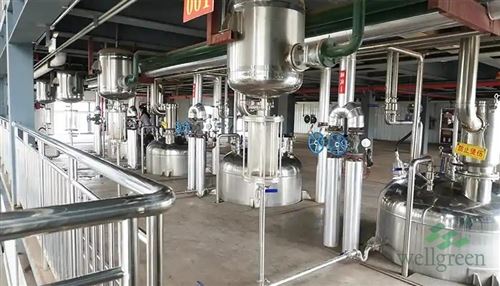
Wellgreen Technology has manufactured botanical extracts since 2011: 120+ employees, a 73,000 m² facility, 3,000 MT annual capacity, seven production lines and seven extraction vessels, with packaging completed in a Class 100,000 cleanroom. Quality control runs on two HPLC units alongside LC-MS, GC and UV-Vis instruments, and the company holds a food production licence, a feed additive production licence, ISO 9001:2015, ISO 22000, HACCP, cGMP, Kosher and Halal certifications - supplying natural food colorants across the hue families described above.
Frequently Asked Questions
Can a natural colorant replace a synthetic dye one-for-one?
Usually not. Natural colorants differ in colour chemistry, shade range, stability and label treatment. Treat the switch as a re-formulation project - target shade first, candidate families second.
Which natural colors work in acidic beverages?
Anthocyanin-based colorants are the natural fit for acidic systems, where they develop red to pink tones; dispersion-form carotenoids and selected reds are also used. Confirm performance in your own matrix - pH, heat and packaging interact [3].
How do I match a specific target shade using plant colors?
Work backwards from the shade: fix pH and base formulation, pick the primary colorant, correct with a small secondary addition, and document the ratio so the shade is repeatable. Same-family blends are easier to control; cross-family blends need compatibility testing.
Are natural colors stable through heat processing?
It depends on the family. Carotenoids are comparatively heat-tolerant but oxidation- and light-sensitive; betanin and phycocyanin are notably heat-sensitive; carmine performs well through many heat processes. The decisive test is your process profile, not a generic ranking.
What information should I send a supplier for a color matching request?
Send the eight-item brief above: target shade, matrix and pH, process conditions, shelf life and packaging, destination markets, blending permission, required documents, and sample/batch expectations.
Request Specifications & Samples
Tell us the target shade, your matrix and your process conditions - we will come back with a candidate colorant list, the specification sheet and a sample plan matched to your case. Commercial terms, including pricing and minimum order quantities, are quoted case by case.
Email: liu@wellgreenxa.com
Tel / WhatsApp: +86-19890982054
Long-term supply partnerships welcome; trial orders and sample evaluation supported. Typical reply within 24 hours.
References
- Regulation (EC) No 1333/2008 on food additives. EUR-Lex. https://eur-lex.europa.eu/eli/reg/2008/1333/oj/eng
- EFSA - Food colours (topic page). https://www.efsa.europa.eu/en/topics/topic/food-colours
- Xue, H., et al. (2024). Factors affecting the stability of anthocyanins and strategies for improving their stability: A review. Food Chemistry: X, 24, 101883. DOI: 10.1016/j.fochx.2024.101883. https://pmc.ncbi.nlm.nih.gov/articles/PMC11497485/
