




Red beet root powder has become one of the more interesting ingredients in the food and beverage industry because it does two jobs at once: it is a natural red colorant and a nitrate-bearing vegetable ingredient. This page sets out what the material is, how it behaves in formulation, and the points a B2B buyer should settle before quoting.

What is in it
The dominant pigment is betanin, a betalain - a nitrogen-containing, water-soluble pigment found in the Caryophyllales and not in the anthocyanin-bearing fruits that supply most other natural reds. That difference matters commercially: betalains and anthocyanins have different stability profiles and are not substitutable on a one-for-one basis. The root also carries nitrate, dietary fibre, folate, potassium and a small polyphenol fraction, and it is the nitrate content, together with the betanin content, that is normally the specification basis.
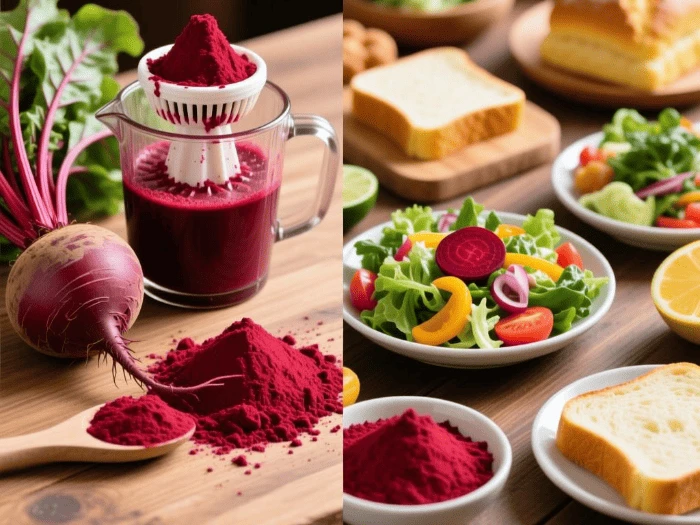
Specification
| Item | Value |
| Product name | Red beet root powder |
| Botanical source | Beta vulgaris |
| Part used | Root |
| Principal pigment | Betanin (betalain) |
| Standardisation | Betanin / colour value and nitrate content stated per grade |
| Appearance | Dark red to purple fine powder |
| Solubility | Water-dispersible |
| Grade | Food grade |
| Test method | HPLC / UV |
| Packaging | 25 kg fiber drum with food-grade inner liner |
| MOQ | Confirmed per order |
| Documents | COA, MSDS, specification sheet |
| Certifications | ISO9001, ISO22000, FSSC22000, HACCP, cGMP, FAMI-QS; HALAL, KOSHER, NOP, EOS where applicable |
Standard market grades are available, and custom specifications can be produced to order. Exact parameters are confirmed per order and stated in the batch Certificate of Analysis.
Formulation and stability - the part that decides whether the colour holds
Betanin is a sensitive pigment, and most of the practical difficulty with beet root powder is a stability problem rather than a sourcing problem. Four factors govern it:
• pH - betalains are most stable in the mildly acidic to neutral range and degrade under strongly acidic conditions and above neutral pH. Formulations built around a low-pH fruit system will lose colour faster than a neutral one.
• Heat - betanin degrades with thermal load. High-temperature pasteurisation and long bake times both cost colour, so where the pigment is the reason for inclusion, the process should be designed around it rather than adjusted afterwards.
• Light and oxygen - extended exposure fades the pigment. Opaque or light-protective packaging and where practical a nitrogen flush extend colour retention through shelf life.
• Particle size - dispersion in beverage systems is better with fine milling, and carriers such as maltodextrin or gum arabic are used to improve powder flow and stability.
A fifth point is sensory. Beet root carries a recognisable earthy note that becomes more prominent as the inclusion rate rises, and above roughly 0.1–0.3% it begins to be perceptible in many food systems. Where colour is the objective, that is the practical use range; where the vegetable content is also wanted, higher levels are used and the flavour is managed with citrus or berry aromatics. Both the working range and the flavour point should be confirmed on a bench trial at the target dose rather than assumed from a specification sheet.
Applications
Red beet root powder is used as a natural red colorant and ingredient in beverages, juice blends, smoothies and drink powders; in bakery, biscuits, snacks and plant-based products; in dairy alternatives; in meat analogues; and as a raw material in dietary supplement capsules and sachets. It is supplied for further manufacturing rather than for direct consumer use. The approved colorant status, permitted use levels and the labelling position of beetroot colour vary by jurisdiction - including the well-known difference between the approved extract and the non-approved "beetroot red" preparation in some markets - and remain the responsibility of the brand owner for the destination market.
What to settle before you compare quotations
Four items. Which parameter the grade is standardised on - betanin, total betalain, colour value or nitrate. The assay method and whether the result is reported as-is or on a dry basis. Whether the material is a juice-derived powder or a whole-root powder, since the fibre and flavour profiles differ. And whether the grade is certified organic, if an organic claim is on the label.
Quality Documentation
Manufacturing is carried out under ISO9001, ISO22000, FSSC22000, HACCP, cGMP and FAMI-QS management systems, and the product range is certified for HALAL, KOSHER, NOP and EOS (organic) where applicable. Each batch is released against a batch-specific Certificate of Analysis, and MSDS and specification sheets are available on request. Certificates are available on request.
Related products
See the red beet root powder (betanin) specification page, or compare with organic blueberry powder and pomegranate fruit powder, which are specified on anthocyanins.
Samples and Enquiries
Evaluation samples are available for qualified enquiries. For specifications, documentation or a quotation, contact our sales team at liu@wellgreenxa.com.
This page describes an industrial botanical ingredient for business-to-business use. It is not intended to diagnose, treat, cure or prevent any disease, and is not intended for direct consumer use.
