




For procurement managers and brand owners evaluating liposomal glutathione powder, a persistent question remains: does oral glutathione actually deliver meaningful results? The short answer is that conventional oral glutathione faces significant bioavailability limitations due to enzymatic degradation in the gastrointestinal tract. However, liposomal glutathione powder employs a fundamentally different delivery mechanism-one that has been shown, in multiple comparative studies, to enhance systemic absorption, cellular uptake, and biological activity. Understanding this mechanism is essential for B2B buyers seeking to develop science‑backed antioxidant and detoxification products.
Key Takeaways (Procurement Checklist)
- Conventional oral glutathione has inherently low bioavailability, with estimates suggesting that widely considered to have limited systemic availability intact due to degradation by the enzyme gamma‑glutamyl transferase (GGT) in the small intestine.
- Liposomal encapsulation protects glutathione from enzymatic breakdown by surrounding the molecule with phospholipid bilayers that mimic cell membranes, allowing direct uptake through the intestinal wall.
- Published human pharmacokinetic studies have reported significantly higher plasma glutathione levels with liposomal formulations, with one comparative study noting a maximum plasma concentration approximately six times higher in a controlled comparative study than plain glutathione.
- For B2B buyers, formulation evaluation criteria should include validated encapsulation efficiency (≥70% typical), particle size distribution (typically 100–300 nm), HPLC‑verified assay (≥95% glutathione), and batch‑specific Certificates of Analysis (COA).
1. Why Conventional Glutathione Struggles: The Gamma‑Glutamyl Transferase Barrier
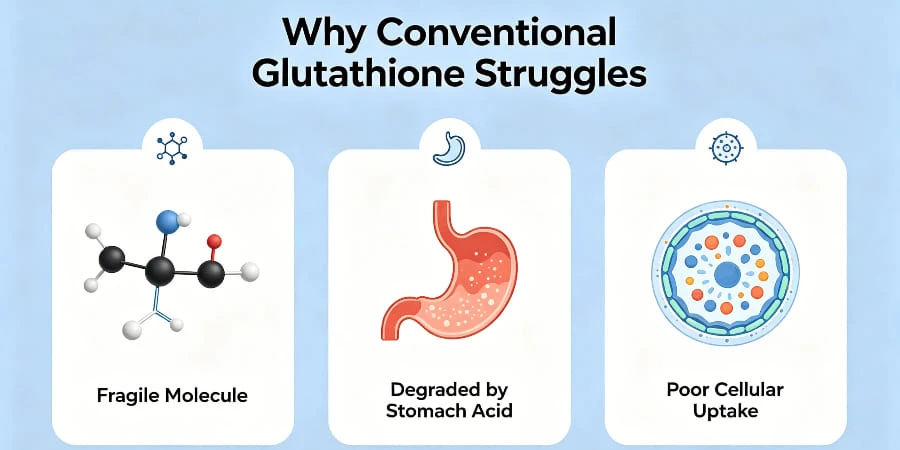
Glutathione (γ‑L‑glutamyl‑L‑cysteinylglycine; GSH) is a tripeptide synthesized intracellularly from three constituent amino acids: glutamate, cysteine, and glycine. It functions as the body's primary intracellular antioxidant, neutralizing reactive oxygen species, detoxifying xenobiotics, and maintaining cellular redox homeostasis. However, when taken orally as a conventional supplement, glutathione encounters a formidable obstacle: the enzyme gamma‑glutamyl transferase (GGT), concentrated on the brush border of the small intestine.
Oral glutathione molecules are rapidly cleaved by intestinal proteases and GGT in the small intestine. GSH is a peptide that is easily broken down in the gastrointestinal tract and during first‑pass metabolism by hepatic GGT, resulting in an oral bioavailability that has been reported as very low. This enzymatic barrier explains why many products relying on standard oral glutathione formulations yield limited and inconsistent clinical outcomes.A 2025 systematic review and meta‑analysis examined the effects of glutathione supplementation on body glutathione levels, noting ongoing concerns about low bioavailability. The fragility of the glutathione molecule means that much of an oral dose is hydrolyzed before it can reach systemic circulation.
Further mechanistic confirmation comes from the broader literature: the enzyme cleaves the γ‑glutamyl bond of extracellular glutathione, glutathione conjugates, and other γ‑glutamyl compounds, releasing free glutamate and the dipeptide cysteinyl‑glycine, which is subsequently hydrolyzed to cysteine and glycine. This rapid degradation is the primary reason conventional oral glutathione products have historically delivered inconsistent consumer outcomes.
2. How Liposomal Encapsulation Changes the Delivery Paradigm
Liposomal technology addresses this bioavailability barrier through a fundamentally different delivery architecture. Liposomal glutathione powder encapsulates the GSH molecule within phospholipid bilayers-microscopic spheres that structurally mimic human cell membranes. This biomimetic design serves three critical industrial purposes:
- Protection from enzymatic degradation: The phospholipid shell shields glutathione from GGT and other proteases throughout the gastrointestinal tract.
- Bypassing first‑pass metabolism: Liposomes are absorbed into the lymphatic system via specialized M‑cells in Peyer's patches, unlike conventional nutrients, which enter the portal circulation and are processed by the liver.
- Direct cellular interaction: The liposomal structure merges with cell membranes, delivering encapsulated glutathione directly into the cytoplasm without relying on saturable transport mechanisms.
Advanced liposomal systems employing small, stable vesicles have been reported to protect the active ingredient during digestion, enhancing potential bioavailability. The encapsulation process also improves stability against oxidation, extending shelf life and reducing formulation risks for finished product manufacturers.One supplier specification indicates that when combined with liposome technology, liposomal glutathione's antioxidant efficiency has been reported to be more than three times higher than that of ordinary glutathione in certain measurements.
3. Clinical Evidence: What Human Studies Show
The pharmacokinetic advantages of liposomal glutathione powder are supported by published human studies, including recent research from 2026.
British Journal of Nutrition Study (2026)
A parallel‑arm, open‑label human pharmacokinetic study (n = 12, 1 g single oral dose) directly compared a novel liposomal glutathione formulation with plain glutathione.
- Cellular uptake: The liposomal formulation demonstrated approximately 1.9‑fold higher cellular uptake than plain glutathione in a human cell model, peaking at 6 hours (45% vs 23%).
- Pharmacokinetics: The liposomal formulation achieved a maximum plasma concentration approximately six times higher than plain glutathione (∼1800 ng/ml vs ∼300 ng/ml), showed a bimodal absorption pattern, and maintained detectable plasma levels at 24 hours.
- Cell proliferation: The liposomal formulation increased cell proliferation by up to three‑fold over control, superior to plain glutathione.
- Wound healing: The liposomal formulation achieved complete closure at 24 hours, compared to approximately 60% for plain glutathione.
The authors concluded that the liposomal formulation significantly improves cellular delivery, biological activity, and systemic bioavailability compared with conventional glutathione, noting its potential applications in antioxidant support and metabolic recovery.
A Targeted Metabolomic Assessment (2026)
A human pilot study from the University of British Columbia evaluated the oral absorption and safety profile of a novel micellar glutathione formulation (LipoMicel®) compared with two commonly used dietary supplement forms: standard glutathione and liposomal glutathione. The novel micellar formulation demonstrated enhanced oral bioavailability compared with the standard preparation and was well-tolerated over 30 days in healthy adults.
Skin Health Applications (Randomized Controlled Trial)
Beyond absorption data, a 12‑week randomized, double‑blind, placebo‑controlled trial investigated the combination of 500 mg L‑Cystine and 250 mg reduced L‑Glutathione in 124 Asian female subjects. A significant skin lightening effect was observed after 12 weeks of oral supplementation, along with a significant reduction in the size of facial dark spots after 6 and 12 weeks. The observed effects were better than those obtained with placebo and also better than with L‑Cystine alone or L‑Glutathione alone. Additionally, a separate double‑blind, placebo‑controlled trial (n = healthy females, 12 weeks, 250 mg/day) reported that both reduced and oxidized glutathione effectively influenced skin properties,, including melanin index, ultraviolet spots, and wrinkles, with a tendency toward increased skin elasticity.
4. Comparing Delivery Formats: A Procurement Perspective
From a procurement perspective, selecting the right delivery format directly impacts formulation efficiency, cost per effective dose, and consumer satisfaction.
| Delivery Format | Bioavailability Profile | Mechanism | Key Considerations for B2B Sourcing |
|---|---|---|---|
| Standard oral glutathione | Limited; estimates often below 10–15% | Tripeptide degraded by GGT; free amino acids absorbed and intracellularly reassembled | Lowest raw material cost; rapid GI degradation; variable outcomes; limited efficacy data for claims |
| Liposomal glutathione powder | Enhanced; studies report significantly higher plasma levels and cellular uptake | Phospholipid encapsulation protects from GGT, lymphatic absorption, and the direct cellular fusion | Higher raw material cost; requires validated encapsulation efficiency (≥70% typical), particle size (100–300 nm), and batch‑specific COA |
| N‑Acetylcysteine (NAC) precursor | 60–70% intestinal absorption | Supports endogenous GSH synthesis via cysteine provision, bypasses some GGT barriers | Moderate cost; strong published evidence; functions as precursor rather than direct GSH supplementation |
| Intravenous glutathione | 100% bioavailability | Direct bloodstream delivery; bypasses entire digestive tract | Highest cost; medical administration required; clinical settings only |
5. Sourcing Considerations for Procurement Teams
For B2B buyers, the transition from conventional glutathione to liposomal glutathione powder requires careful supplier evaluation. Key procurement criteria include:
- Analytical documentation (non‑negotiable): Batch‑specific Certificates of Analysis (COA) including HPLC‑verified glutathione content (≥95% typical), heavy metal analysis (ICP‑MS), microbiological safety data, and residual solvent reports.
- Encapsulation efficiency and particle size: Reliable suppliers provide validated documentation of particle size distribution (typically 100–300 nm) and encapsulation efficiency (≥70% is often cited as a typical industrial benchmark). Encapsulation efficiency can vary between formulations, ranging from 20–40% in some systems to over 80% in advanced processes.
- Stability data: ICH‑compliant stability studies supporting shelf‑life claims (24–36 months at room temperature for properly stored powder formats). Storage requirements typically include cool, dry conditions away from direct light and heat.
- Certifications and compliance: Manufacturing certifications (cGMP, ISO 22000, FSSC 22000, HACCP) and market‑specific certifications (Kosher, Halal, Non‑GMO Project Verified, organic where applicable).
- Supply chain transparency: Documented raw material traceability, annual production capacity, batch‑to‑batch consistency data, and regional warehousing options to support global distribution.
From a commercial standpoint, liposomal glutathione powder carries a higher raw material cost per kilogram than conventional glutathione, but enhanced bioavailability supports lower effective dosage requirements, premium brand positioning, and reduced consumer complaint risk from inconsistent absorption.
6. Conclusion
For B2B procurement managers and product developers, the question is no longer whether oral glutathione can be effective-it is which delivery system provides the consistent, predictable bioavailability required for a successful finished product. Standard oral glutathione faces a well‑characterized enzymatic barrier that limits systemic availability. Liposomal glutathione powder, supported by published human pharmacokinetic studies, achieves significantly higher cellular uptake and systemic bioavailability while maintaining formulation flexibility. By partnering with a technically transparent supplier that provides validated encapsulation efficiency data, batch‑specific analytical documentation, and full regulatory dossiers, manufacturers can deliver differentiated, science‑supported glutathione products that address the clear market demand for bioavailable antioxidant formulations.
Next Steps for Your Formulation
Most clients begin with a pilot batch (100‑500 g) to validate dispersibility, stability, and liposome integrity in their specific matrix before scaling to commercial production. Batch‑specific COA, stability data, and formulation guidance are available to support your product development process.
- [Request technical samples] – Test our liposomal glutathione powder grades (≥95% purity) in your own matrix.
- [Access technical documentation] – Review HPLC assay reports, heavy metal analysis, microbiological safety data, and 24‑month stability studies.
- [Discuss custom specifications] – Explore custom concentrations, particle size, or processing options.
- [Schedule a formulation consultation] – Meet with our R&D team to address glutathione bioavailability, stability, or application‑specific challenges.
MOQ, lead time, and bulk pricing available upon request. For technical support, formulation consultation, and bulk quotations, contact our engineering team at liu@wellgreenxa.com.
Frequently Asked Questions (FAQ)
Is liposomal glutathione powder better than NAC?
Liposomal glutathione powder and N-acetylcysteine (NAC) serve different functional roles in formulation. NAC acts as a precursor that supports endogenous glutathione synthesis by supplying cysteine, while liposomal glutathione delivers the active tripeptide directly. Liposomal delivery systems are designed to enhance the stability and absorption of glutathione, whereas NAC relies on the body's ability to synthesize glutathione intracellularly. The choice between the two depends on formulation goals, target claims, and desired mechanism of action.
What is the optimal particle size for liposomal glutathione powder?
Most commercially validated liposomal glutathione systems fall within the 100–300 nm particle size range. This size range is generally considered optimal for stability, intestinal uptake, and dispersion in various delivery formats. Smaller particles may improve absorption efficiency but require more advanced processing and stability control. Procurement teams should request batch-specific particle size distribution data (e.g., DLS reports) to ensure consistency.
What encapsulation efficiency should be expected?
Encapsulation efficiency for liposomal glutathione powder typically ranges from 50% to over 80%, depending on the production technology and formulation system. Higher encapsulation efficiency indicates a greater proportion of active glutathione protected within liposomes, which is important for both stability and performance. Reliable suppliers should provide validated encapsulation efficiency data for each batch.
How stable is liposomal glutathione in powder form?
When properly manufactured and stored under controlled conditions (cool, dry, airtight), liposomal glutathione powder can achieve a shelf life of 24–36 months. Stability depends on factors such as phospholipid quality, residual moisture, and packaging. ICH-compliant stability data should be reviewed during supplier evaluation.
Can liposomal glutathione powder be used in functional foods and beverages?
Yes, liposomal glutathione powder can be incorporated into various delivery formats, including capsules, sachets, and certain functional beverages. However, formulation compatibility must be evaluated, especially for heat processing, pH sensitivity, and shear stability. Pilot testing is recommended before commercial production.
References
Prasad, K. N., Chandrashekar, C., Karthik, Y., Vasantha, G. G., & Phadnis, S. (2026). Liposomal glutathione outperforms plain glutathione in uptake, cell regeneration, and systemic availability: evidence from cellular and human models. British Journal of Nutrition, 1‑8.
https://doi.org/10.1017/S0007114526106254- Enhancing the Oral Bioavailability of Glutathione (GSH) Using Chemical Modification Approaches. (2018). University of Auckland thesis.
Enhancing the Oral Bioavailability of Glutathione Using Innovative Analogue Approaches. (2025). Pharmaceutics, 17(3), 385.
https://doi.org/10.3390/pharmaceutics17030385- Hastings, J. (2026). Glutathione Supplement: Clinical Evidence and Biomarker Context. PlexusDx.
- Glutathione Levels after Glutathione Supplementation: A Systematic Review and Meta‑analysis. (2024). Journal of Current Science and Technology, 15(1), Article 90.
- A Targeted Metabolomic Assessment of Oral Glutathione Bioavailability and Safety in Humans: A Randomized Crossover Clinical Trial. (2026). University of British Columbia.
- Oral delivery of glutathione: antioxidant function, barriers and strategies. (2022). DOAJ.
