




For procurement managers and brand owners evaluating liposomal NMN powder formulations, the key question is no longer whether NMN works-but how to design a formulation that delivers consistent and measurable results. While standard NMN products focus primarily on NAD⁺ elevation, liposomal NMN powder enables more advanced formulation strategies by improving stability and potentially enhancing bioavailability.
Increasingly, formulators are moving beyond single-ingredient approaches and adopting stacked formulations based on liposomal NMN powder, combining NMN with complementary compounds such as resveratrol, quercetin, PQQ, and CoQ10. Current clinical and preclinical evidence suggests that targeting NAD⁺ metabolism alongside mitochondrial function, redox balance, and sirtuin-related pathways may provide a more comprehensive approach to cellular health support.
This guide provides a science-grounded rationale for liposomal NMN stacking, outlines commercially validated ingredient combinations, and offers formulation parameters to help procurement teams evaluate multi-ingredient NMN blends.
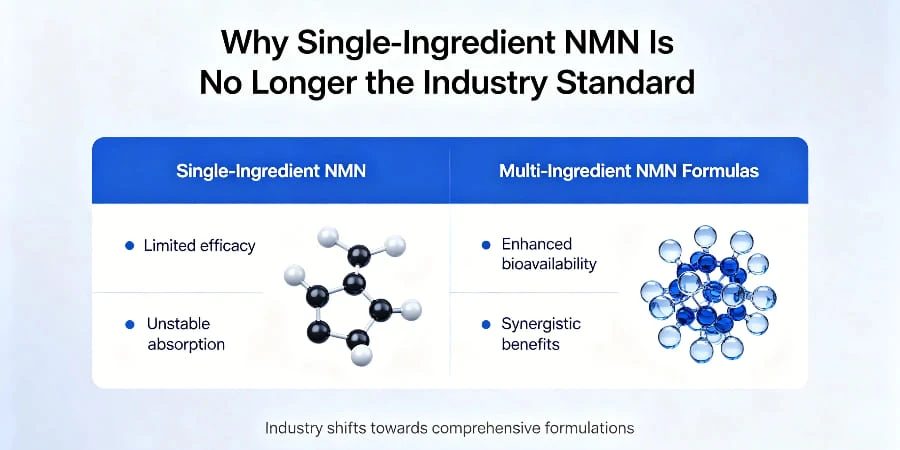
1. Why Single‑Ingredient NMN Is No Longer the Industry Standard
Standard NMN formulations, while supported by evidence for NAD⁺ elevation, address only one aspect of the cellular aging process. Aging involves interconnected hallmarks: NAD⁺ depletion, mitochondrial dysfunction, oxidative stress, and epigenetic dysregulation. A 2026 review in Redox Biology presented a conceptual "tri‑axis anti‑aging model" encompassing NMN/NR (NAD⁺ homeostasis), PQQ (mitochondrial quality control), and L‑ergothioneine (redox stability). The review argued that single‑pathway interventions may be less effective than multi‑target strategies in mitigating age‑related functional decline, supporting the formulation rationale for combination approaches rather than single‑ingredient products.
For procurement teams, the implication is that brands transitioning to stacked formulations may gain a commercial edge by offering more comprehensive cellular support.
2. The NMN + Resveratrol Combination: Substrate Meets Activator
The theoretical basis for combining NMN and resveratrol is grounded in complementary mechanisms. NMN serves as a direct NAD⁺ precursor, while resveratrol has been investigated in numerous preclinical studies for its ability to influence sirtuins-a family of proteins involved in cellular regulation and longevity pathways. The theoretical mechanistic logic is straightforward: combining an NAD⁺ precursor (NMN) with a sirtuin‑modulating compound (resveratrol) may address two distinct sides of the cellular equation. However, it is important to note that the direct activation of SIRT1 by resveratrol continues to be debated in the scientific literature. Preclinical data support the idea that NMN and resveratrol together may influence sirtuin activity, mitochondrial function, and metabolic health more than either compound alone, but most available evidence remains preclinical.
Real‑world formulation data confirm that this combination has strong consumer resonance, with liposomal or delayed‑release capsule formats preferred to improve bioavailability. Commercial products have successfully incorporated this pairing, often sourcing resveratrol from Polygonum cuspidatum (giant knotweed) for its concentrated trans‑resveratrol content.
Formulation parameters:
- Dosage ratio: Market formulations typically use 250–500 mg NMN with 100–250 mg trans‑resveratrol per serving.
- Delivery system: Liposomal or microencapsulated formats for both NMN and resveratrol may improve bioavailability of both compounds, but formulators should validate performance in their specific matrix.
- Sourcing synergy: Single‑source suppliers offering both ingredients with validated stability data can reduce procurement complexity.
3. The NMN + Quercetin Combination: Senolytic‑Related Activity and Sirtuin Modulation
Quercetin serves two complementary functions in an NMN stack. First, like resveratrol, it has been investigated for its ability to modulate sirtuin activity, which may complement NAD⁺ elevation. Second, quercetin has been studied for its senolytic properties-the ability to influence the clearance of aging cells that accumulate over time and contribute to chronic inflammation. A 2024 phase‑2 randomized controlled trial of intermittent dasatinib plus quercetin (D+Q) in postmenopausal women (n=60 participants) was conducted to assess effects on bone metabolism. While the primary endpoint (bone resorption marker CTx) did not differ between groups, exploratory analyses suggested that women with a higher baseline senescent cell burden showed transient increases in bone formation markers at 2 and 4 weeks, indicating that the underlying senescent cell burden may influence clinical response. No serious adverse events were observed.
Notably, quercetin is a dietary flavonoid with antioxidant, anti‑inflammatory, and senolytic properties, yet its effects on DNA damage response and inflammatory markers in healthy humans remain an area of active investigation.
Formulation parameters:
- Dose range: 100–250 mg quercetin dihydrate per serving (typically in a1:1 to 1:2 ratio with NMN).
- Delivery considerations: Quercetin's bioavailability can be enhanced by liposomal encapsulation, aligning with NMN's delivery technology.
4. The NMN + PQQ + CoQ10 Stack: Tri‑Axis Mitochondrial Support
PQQ (pyrroloquinoline quinone) and CoQ10 are mitochondrial cofactors that complement NMN's NAD⁺‑boosting mechanism. A 2026 review in Ageing Research Reviews systematically compared PQQ and NMN/NR, emphasizing their complementary pathways to support healthy aging. PQQ exerts its anti‑aging effect primarily through enhancing mitochondrial biogenesis, exerting antioxidant activity, and modulating inflammatory pathways. NMN/NR act as key precursors in NAD⁺ biosynthesis. The review highlighted the need for robust studies on the synergistic potential of PQQ and NMN/NR, noting that while preliminary evidence supports their complementary strategies, strong scientific evidence encouraging their combined anti‑aging potential remains limited.
A 2026 study in Frontiers in Aging evaluated a multicomponent formulation containing NMN, NADH, CoQ10, PQQ, resveratrol, and glutathione in human epithelial cell models. The formulation significantly improved redox homeostasis, evidenced by increased total antioxidant status and reduced total oxidant levels, and upregulated longevity‑associated genes including FOXO3A, APOE, and GPX1, indicating activation of pathways associated with antioxidant defense, anti‑inflammatory signaling, and metabolic regulation.
Procurement checklist for mitochondrial stacks:
- PQQ concentration: Look for ≥98% purity with validated mitochondrial biogenesis data (typically 5–20 mg/serving).
- CoQ10 form: Ubiquinone (standard) vs. ubiquinol (reduced); liposomal delivery may improve absorption of both forms.
- Stability data: Combined formulations require compatibility testing, particularly for oxidation‑sensitive ingredients.
5. Supporting Players: TMG and Methylation Balance
NMN metabolism produces nicotinamide (NAM) as a byproduct, which requires methylation for clearance. High‑dose NMN without adequate methyl group replenishment may risk depleting methylation capacity over time. TMG (trimethylglycine, also known as betaine) serves as a methyl donor, supporting methylation balance during NMN metabolism. Formulators may consider incorporating TMG (250–500 mg per serving) alongside NMN as a complementary addition based on mechanistic rationale.
6. Putting It All Together: Stacking Tiers and Commercial Formulation Examples
| Tier | Components | Typical Dosage Range (Per Serving) | Target Mechanisms (as supported by preclinical/clinical evidence) |
|---|---|---|---|
| Foundation | NMN only | 250–500 mg | NAD⁺ elevation |
| Advanced | NMN + Resveratrol + Quercetin | NMN 250–500 mg / Resveratrol 100–250 mg / Quercetin 100–250 mg | NAD⁺ + sirtuin modulation + senolytic‑related activity |
| Mitochondrial | NMN + PQQ + CoQ10 | NMN 250–500 mg / PQQ 5–20 mg / CoQ10 50–100 mg | NAD⁺ + mitochondrial biogenesis + electron transport support |
| Comprehensive | NMN + Resveratrol + Quercetin + PQQ + CoQ10 + TMG | As above combined | Multi‑pathway cellular support (represented in premium commercial products) |
7. Cost Implications for Procurement
Stacked formulations increase raw material costs, but the per‑ingredient expense must be weighed against:
- Reduced multi‑bottle SKUs – A single stacked product can replace separate NMN, resveratrol, and CoQ10 bottles, reducing manufacturing complexity and warehousing.
- Premium pricing justification – Science‑supported stacking may support higher retail pricing, improving margin on a per‑unit basis compared to single‑ingredient products.
- Customer lifetime value – Stacked products targeting comprehensive cellular health may achieve higher retention rates than single‑mechanism formulations.
When evaluating suppliers for stacked formulations, prioritize manufacturers that provide: (1) batch‑specific COA for each active ingredient, (2) stability data for the full blend (6‑12 months minimum at 40°C/75% RH), (3) compatibility testing results, and (4) certifications (cGMP, ISO 22000, Kosher, Halal as applicable).
8. Conclusion
For B2B procurement managers and product developers, the emerging scientific literature-including the 2026 Redox Biology tri‑axis framework and the Ageing Research Reviews comparison of PQQ and NMN/NR-suggests that stacked NMN formulations addressing interconnected hallmarks of cellular aging may offer a more comprehensive approach than single‑ingredient products. By selecting a technically capable supplier that provides full analytical transparency across all active components and compatibility data for the blend, manufacturers can deliver differentiated, science‑supported products that address multiple pathways associated with cellular aging and position their brands for success in the expanding longevity market.
Next Steps for Your Formulation
Most clients begin with a pilot batch (500‑1,000 capsules or 100‑500 g of powder blend) to validate dispersibility, stability, and compatibility across stacked ingredients before scaling to commercial production. Batch‑specific COA, blend stability data, and formulation guidance are available to support your product development process.
- [Request technical samples] – Test our NMN powder grades (≥98% purity) or custom‑blended stacks incorporating resveratrol, quercetin, PQQ, CoQ10, or TMG.
- [Access technical documentation] – Review HPLC assay reports, heavy metal analysis, microbiological safety data, and 24‑month stability studies (individual components and blends).
- [Discuss custom formulations] – Explore stacked ratios, liposomal delivery options, and compatibility testing for multi‑ingredient blends.
- [Schedule a formulation consultation] – Meet with our R&D team to address stacking strategies, methylation balancing, or application‑specific formulation challenges.
MOQ, lead time, and bulk pricing available upon request. For technical support, formulation consultation, and bulk quotations, contact our engineering team at liu@wellgreenxa.com.
References
- Ulpathakumbura, S., et al. (2026). Comparison of the anti-aging effect of PQQ (Pyrroloquinoline quinone) and NMN/NR (Nicotinamide mononucleotide /Nicotinamide riboside) – possible combination use. Ageing Research Reviews, 114, 102992. DOI: 10.1016/j.arr.2025.102992. [7†L2-L9]
- An integrated anti-aging framework targeting NAD+ homeostasis, mitochondrial quality control, and redox stability: Roles of NMN/NR, PQQ, and EGT. (2026). Redox Biology, 93, 104191. DOI: 10.1016/j.redox.2026.104191. [9†L5-L9]
- Karcıoğlu Batur, L., et al. (2026). Effects of Kiperin Elixea, a multicomponent antioxidant supplement, on redox homeostasis and longevity-associated gene expression in human epithelial cell models. Frontiers in Aging. DOI: 10.3389/fragi.2026.1843098. [11†L16-L39]
- Farr, J. N., et al. (2024). Effects of intermittent senolytic therapy on bone metabolism in postmenopausal women: a phase 2 randomized controlled trial. Nature Medicine, 30(9), 2605-2612. : NCT04313634. [12†L20-L42]
- Nicotinamide mononucleotide increases muscle insulin sensitivity in prediabetic women. Science, 2021. PMID: 33888596. [10†L31-L33]
