




Glutathione has earned its place as a cornerstone of the beauty-from-within category, but conventional oral forms have long struggled with poor bioavailability and inconsistent results. This performance gap has been a persistent challenge for brands seeking to develop credible science-backed skin health products.
For procurement managers and brand owners, the question is no longer whether glutathione works for skin, but how to formulate it for predictable, verifiable outcomes. Liposomal glutathione powder-with its significantly enhanced absorption and cellular delivery-has emerged as the delivery platform that finally enables oral glutathione to deliver measurable skin benefits.
This guide examines the beauty-from-within megatrend driving liposomal glutathione demand, the clinical evidence behind glutathione's skin-lightening mechanisms, and key formulation considerations for B2B buyers developing beauty supplements.
Key Takeaways (Procurement Checklist)
- Skin health drives over 40% of nutricosmetics demand, with the global beauty supplement market projected to grow from USD 2.8 billion in 2025 to USD 5.1 billion by 2032 at a 9% CAGR.
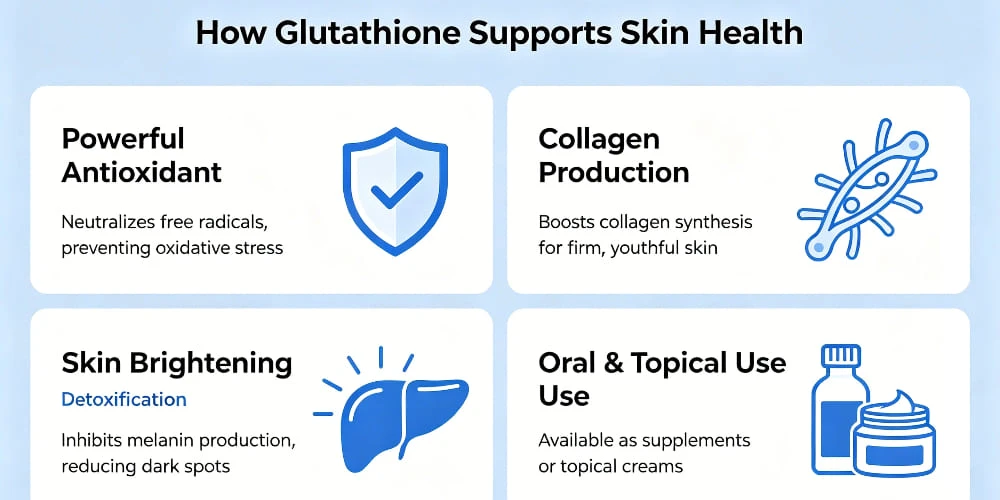
- Glutathione's melanin-reducing mechanisms include direct tyrosinase inhibition (copper chelation), switching melanogenesis from dark eumelanin to light pheomelanin, and antioxidant protection against oxidative stress.
- Clinical studies have established a dosing benchmark: A 2019 systematic review found that 500 mg/day oral glutathione could brighten skin color in sun-exposed areas.
- Conventional glutathione suffers from <15% absorption. Liposomal encapsulation elevates bioavailability to 30–50%, making oral glutathione formulations commercially viable.
- The Asia-Pacific region leads the market with 62% of future growth in consumer health projected to come from APAC, where beauty-from-within supplements are already a staple.
1. Market Momentum: Beauty-from-Within by the Numbers
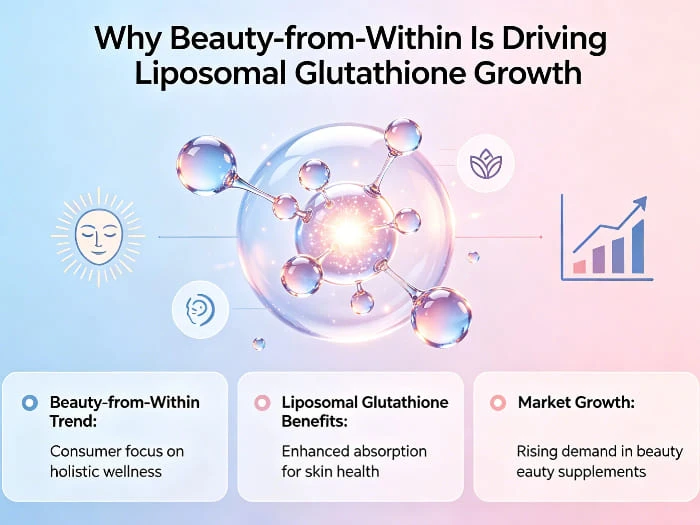
The beauty-from-within category has moved decisively from niche to mainstream. The global beauty supplement market was valued at USD 2.8 billion in 2025 and is projected to reach USD 5.1 billion by 2032, a compound annual growth rate (CAGR) of 9.0%. The broader nutricosmetics market-ingestible products positioned for skin, hair, and nail benefits-grew from USD 9.4 billion in 2025 to USD 10.21 billion in 2026 and is forecast to reach USD 15.41 billion by 2031 at an 8.6% CAGR.
Several factors are driving this growth:
Holistic wellness convergence: Consumers increasingly accept that skin health reflects internal wellness, driving demand for supplements that address multiple health dimensions simultaneously
.
Millennial and Gen-Z adoption: These cohorts account for the bulk of beauty supplement adoption, with a 60% higher propensity to pay for science-backed products
.
Online channel growth: In 2025, online sales of beauty supplements grew by 8% annually, and online retail now dominates the glutathione supplements channel with a 55% share
.
Globally, the glutathione supplements market is valued at USD 381.5 million in 2025 and is forecast to reach USD 729.3 million by 2035, a CAGR of 6.7%
. Within the antioxidant supplements segment, glutathione accounts for an estimated 5–7% of the market, reflecting strong positioning as a master antioxidant
.
The Asia-Pacific region leads with nearly half of global nutricosmetics revenue, while North America is expanding fastest as regulatory clarity and subscription e-commerce raise average selling prices. Japan is projected to grow at a 7.2% CAGR, driven by demand for anti-aging and skin health supplements, and the U.S. is expected to register 6.8% growth
.
2. How Glutathione Supports Skin Health: The Science
The skin-lightening effects of glutathione are grounded in multiple complementary mechanisms, all of which require adequate systemic levels to be effective.
Melanin Modulation Pathways
Glutathione influences melanin synthesis through at least three distinct pathways:
Direct tyrosinase inhibition: Glutathione's thiol group chelates copper at the active site of tyrosinase, reducing the enzyme's ability to catalyze melanin formation
.
Redirection of melanogenesis: Glutathione can shift pigment production from darker eumelanin toward lighter pheomelanin
.
- Antioxidant protection: By neutralizing oxidative stress, glutathione helps protect skin cells from UV-induced damage and supports overall cellular resilience
A 2019 systematic review of clinical studies concluded that oral glutathione at 500 mg/day could brighten skin color in sun-exposed areas, with measurable reductions in the melanin index
. The same review noted trends toward improved skin elasticity and reduction in UV spots
. The combination of topical and oral glutathione has also demonstrated superior results compared to either route alone.
Importantly, the review emphasized that while there is a trend toward skin-brightening benefits, the clinical efficacy of oral glutathione remains constrained by limited absorption and bioavailability. This limitation is precisely what liposomal encapsulation addresses.
The Bioavailability Barrier-and the Solution
Glutathione is a tripeptide that is easily broken down in the gastrointestinal tract and during first-pass metabolism. Conventional oral glutathione suffers from bioavailability estimates of 18–20%, meaning the majority of an oral dose never reaches systemic circulation. This explains why many oral glutathione products have historically delivered inconsistent outcomes.
Liposomal encapsulation changes this equation. By surrounding glutathione molecules with phospholipid bilayers, liposomes protect the active ingredient from enzymatic degradation, facilitate lymphatic absorption bypassing first-pass metabolism, and enable direct cellular interaction.A 2026 clinical pharmacokinetic study comparing liposomal glutathione with plain glutathione provided strong supporting data. After a single 1 g oral dose, the liposomal formulation achieved a maximum plasma concentration approximately six times higher than plain glutathione and maintained detectable plasma levels at 24 hours. Cellular uptake was ~1.9-fold higher, and the liposomal formulation achieved 100% wound closure at 24 hours compared to 59.8% for plain glutathione. Bioavailability estimates for liposomal glutathione rise to 30–50%, making oral glutathione formulations commercially viable.
3. Why Liposomal Glutathione Is the Preferred Choice for Beauty Formulations
The technical superiority of liposomal glutathione powder translates directly into formulation value for beauty-from-within products.
From Marginal Effects to Predictable Outcomes
Conventional oral glutathione, even at 500 mg/day, often produces marginal results in clinical settings due to low absorption. In one randomized, double-blind, placebo-controlled study, 500 mg twice daily for four weeks failed to raise plasma glutathione levels meaningfully in healthy volunteers. A 2026 comparison found that while IV glutathione reduced melanin index by 15–22% over 8–12 weeks, standard oral glutathione at 500–1,000 mg daily showed only 2–6% reduction or no measurable effect.
Liposomal encapsulation elevates systemic delivery to levels that can meaningfully influence melanin synthesis. For B2B buyers, this transforms glutathione from an ingredient with inconsistent real-world outcomes into one that delivers predictable, measurable performance.
Premium Positioning and Brand Differentiation
The clean-label and science-backed positioning of liposomal glutathione commands stronger retail pricing and higher margins. Consumers are increasingly discerning about ingredient effectiveness, with millennials and Gen-Z showing a strong willingness to pay for science-backed products. Liposomal formulations are positioned as superior, enabling brands to justify premium price points and build consumer trust.
The liposomal glutathione market itself is growing rapidly, valued at USD 435 million in 2024 and projected to reach USD 1.12 billion by 2033, a robust 10.8% CAGR. This growth is driven by increasing consumer awareness of antioxidant supplementation, the rising demand for advanced delivery systems, and surging adoption across dietary supplements, cosmetics, and pharmaceuticals
.
Brands that transition from standard glutathione to liposomal formulations tap into this growth trajectory with a clear differentiator: an ingredient form that actually delivers the skin health benefits consumers expect.
4. Formulating with Liposomal Glutathione: Technical Considerations
When evaluating liposomal glutathione powder for beauty applications, procurement teams should prioritize:
- Analytical documentation: Batch-specific COA including HPLC-verified content (≥95% typical), heavy metal analysis (ICP-MS), and microbiological safety data.
- Encapsulation efficiency and particle size: Reliable suppliers provide validated particle size distribution (typically 100–300 nm) and encapsulation efficiency (≥70% typical benchmark).
- Stability data: ICH-compliant stability studies supporting 24‑36 month shelf life at room temperature.
- Certifications and compliance: cGMP, ISO 22000, FSSC 22000, HACCP, Kosher, Halal, Non-GMO Project Verified.
- Supply chain transparency: Documented raw material traceability, batch-to-batch consistency, and regional warehousing.
The higher raw material cost of liposomal glutathione is offset by lower effective dosage requirements, premium brand positioning, and reduced consumer complaint risk from inconsistent absorption.
5. Conclusion
For B2B procurement managers and product developers, the beauty-from-within market presents a clear growth opportunity-one where science-backed efficacy and premium positioning are decisive competitive advantages. Conventional oral glutathione, constrained by poor bioavailability, has struggled to deliver the consistent results that discerning consumers demand. Liposomal glutathione powder fundamentally changes this paradigm: it protects the active molecule, bypasses first-pass metabolism, and elevates systemic bioavailability to levels capable of meaningfully influencing melanin synthesis and antioxidant defense. By partnering with a technically transparent supplier that provides validated encapsulation efficiency data, batch-specific analytical documentation, and full regulatory dossiers, manufacturers can confidently launch beauty-from-within products that deliver on their promise-and capture share in one of the fastest-growing segments of the nutraceutical market.
Next Steps for Your Formulation
Most clients begin with a pilot batch (100–500 g) to validate dispersibility, stability, and liposome integrity before scaling to commercial production. Batch-specific COA, stability data, and formulation guidance are available to support your product development process.
- [Request technical samples] – Test our liposomal glutathione powder grades (≥95% purity) in your own beauty or wellness matrix.
- [Access technical documentation] – Review HPLC assay reports, heavy metal analysis, microbiological safety data, and 24‑month stability studies.
- [Discuss custom specifications] – Explore custom concentrations, particle size, or processing options.
- [Schedule a formulation consultation] – Meet with our R&D team to address glutathione bioavailability, stability, or application-specific challenges.
MOQ, lead time, and bulk pricing available upon request. For technical support, formulation consultation, and bulk quotations, contact our engineering team at liu@wellgreenxa.com.
References
- Mordor Intelligence. (2026). Nutricosmetics - Market Share Analysis, Industry Trends & Statistics, Growth Forecasts (2026-2031). [11†L7-L9]
- Future Market Insights. (2025). Glutathione Supplements Market Outlook 2025 to 2035. [10†L6-L7]
- PlexusDx. (2026). Glutathione Reviews: Evidence, Biomarkers, and Realistic Clinical Outcomes. [0†L49-L51]
- Sonthalia, S., et al. (2016). Glutathione as a skin whitening agent: Facts, myths, evidence and controversies. Indian Journal of Dermatology, Venereology and Leprology, 82(3), 262-272. PMID: 27088927. DOI: 10.4103/0378-6323.179088.
- Dilokthornsakul, W., et al. (2019). The clinical effect of glutathione on skin color and other related skin conditions: A systematic review. Journal of Cosmetic Dermatology, 18(3), 728-737. PMID: 30895708. DOI: 10.1111/jocd.12910.
- Prasad, K. N., Chandrashekar, C., Karthik, Y., Vasantha, G. G., & Phadnis, S. (2026). Liposomal glutathione outperforms plain glutathione in uptake, cell regeneration and systemic availability: evidence from cellular and human models. British Journal of Nutrition, 1-8. Cambridge University Press.
- Khanna, R., Rambhia, P., & Chapas, A. (2025). Systematic Review of the Efficacy and Safety of Topical Glutathione in Dermatology. Journal of Clinical and Aesthetic Dermatology, 18(9), 51-54. [14†L3-L6]
