




Mushroom extracts have moved from niche adaptogen shelves into mainstream functional foods, beverages, and daily-use supplements. But when formulators sit down to choose a raw material, three names come up again and again: chaga, reishi, and lion's mane. They are often marketed as if they were interchangeable "immune mushrooms" - they are not.
Each species carries a different bioactive profile, a different sensory footprint, and a different set of formulation constraints. Choosing the wrong one can mean a product that tastes off, separates in the bottle, or simply does not support the claim on the label.
This guide compares the three extracts from a B2B formulator's perspective: actives, specifications, solubility, typical applications, and the sourcing questions worth asking before you commit to a bulk order.
Why Mushroom Extracts Are Booming in Functional Products
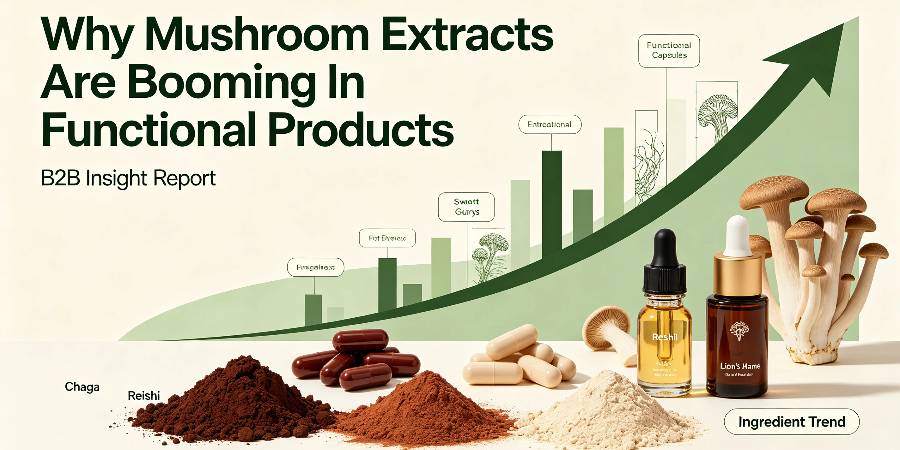
Consumer demand for plant-based, clean-label wellness ingredients has pushed mushroom extracts into categories that barely existed a decade ago: mushroom coffee, functional gummies, ready-to-drink tonics, and even pet supplements. Suppliers have responded with a wide range of extract ratios and standardized actives - and that variety is exactly what makes comparison necessary.
Three commercial realities drive the trend:
- Multi-functional positioning. A single mushroom ingredient can sit inside an immune, cognitive, or adaptogenic story - useful when brands want one SKU to cover several marketing angles.
- Label-friendly sourcing. Mushroom names are recognizable to consumers, unlike many technical ingredient names.
- Formulation versatility. Extracts are available as fine powders that disperse into capsules, tablets, stick packs, and beverages - provided the specification is chosen correctly.
The three species below dominate B2B inquiries for different reasons, and understanding those reasons is the first step toward a defensible formulation.
Bioactive Profile: β-Glucans, Triterpenes and Polysaccharides Compared
All three species contain β-glucans, the polysaccharide family most often associated with immune-support positioning. Beyond that, they diverge sharply.
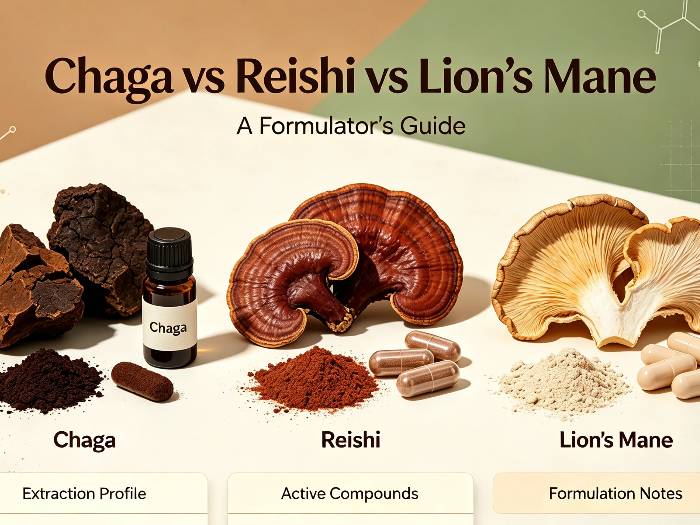
- Chaga (Inonotus obliquus) grows primarily on birch trees and is rich in melanin-type polyphenols, oxidative stress–related compounds, and β-glucans. Its extract is typically dark brown to black, with an earthy, slightly bitter profile. Chaga is most often positioned around antioxidant and immune support.
- Reishi (Ganoderma lucidum) is valued for triterpenes - including ganoderic acids - alongside β-glucans. Triterpenes are the compounds most often discussed in relation to stress resilience and adaptogenic positioning, and reishi extracts are commonly standardized on both polysaccharides and triterpenes. The powder is typically tan to brown with a distinctly bitter note.
- Lion's mane (Hericium erinaceus) is studied for hericenones and erinacines, compounds that have attracted attention in cognitive and nerve-related research. It is the mildest of the three in flavor, which is one reason it appears so often in coffee blends and everyday supplements. Note that most published findings on these compounds remain at the in vitro and animal-study stage - responsible suppliers describe them as research areas, not established human outcomes.
Chaga vs Reishi vs Lion's Mane - Feature Comparison
| Attribute | Chaga (Inonotus obliquus) | Reishi (Ganoderma lucidum) | Lion's Mane (Hericium erinaceus) |
|---|---|---|---|
| Key bioactives | β-glucans, melanin polyphenols | β-glucans, triterpenes (ganoderic acids) | β-glucans, hericenones, erinacines |
| Common positioning | Antioxidant & immune support | Adaptogenic & immune support | Cognitive & nerve support |
| Typical extract ratios | 10:1, 20:1 (market-common) | 10:1, 15:1; standardized polysaccharides/triterpenes | 8:1, 10:1; often standardized on β-glucan or polysaccharides |
| Polysaccharide specs seen in market | ≈10%–50% (UV/VIS) | ≈10%–30%, plus triterpene % | ≈10%–30%, often ≥25% β-glucan grades |
| Color | Dark brown to black | Tan to brown | Light tan to cream |
| Flavor intensity | Strong, earthy, bitter | Strong, bitter | Mild, slightly sweet |
| Water dispersibility | Moderate to good (fine-mesh grades) | Moderate | Good |
| Typical formats | Capsules, tablets, RTD, coffee blends | Capsules, tablets, powders, tinctures | Gummies, stick packs, coffee, capsules |
Specification ranges above reflect common marketplace standards, not a commitment by any single supplier. Always request a specification sheet and COA for the exact grade you intend to purchase.
Formulation Scenarios: Immune, Cognitive and Adaptogenic Positioning
- Choose chaga when the product story centers on antioxidant defense or immune support, and the formula can tolerate a darker color and a pronounced earthy taste - capsules, tablets, and coffee blends absorb it well. Chaga also pairs naturally with vitamin C and zinc in immune-positioned products.
- Choose reishi when the angle is adaptogenic balance, stress resilience, or sleep-adjacent routines. Its bitterness is the main constraint: in beverages, plan for masking agents or pair it with stronger flavors. Reishi is a common component in evening and "calm" SKUs.
- Choose lion's mane when cognitive support or everyday wellness positioning matters, especially in taste-sensitive formats. Its mild flavor makes it the easiest of the three to include in gummies, instant sticks, and ready-to-drink products without heavy flavor masking.
Many brands ultimately combine two or three of these extracts - a "mushroom complex" - in which case the lead ingredient should be the one whose actives justify the primary claim, with the others supporting the blend.
Specifications, Solubility and Sensory Considerations
When comparing quotations from different suppliers, normalize these variables before comparing price per kilogram:
- Extract ratio vs standardized actives. "10:1" describes raw-material input, not potency. Two 10:1 chaga extracts can differ significantly in polysaccharide content. Ask for the standardized parameter and its test method (UV/VIS is common; HPLC is used for specific marker compounds).
- Mesh size and dispersibility. A 80-mesh powder behaves very differently from a 100-mesh grade in beverage applications. Request samples at the exact mesh you will use in production.
- Moisture and flowability. High moisture content causes caking in stick packs and capsules. A water content specification (typically ≤5%–7% for botanical powders) should appear on the COA.
- Microbiological and heavy-metal limits. For EU and US markets, confirm limits against the destination regulation before placing the order.
- Sensory trial. For beverages and gummies, run a small bench trial - bitterness from chaga and reishi can be amplified by certain sweetener systems.
Sourcing Checklist & FAQ
A short checklist before you buy
- Request specification sheet + COA for the exact grade quoted
- Confirm extract ratio AND standardized actives (both, not either)
- Ask for the test method behind each specification
- Verify certifications relevant to your market (for example cGMP, ISO 22000, HACCP, HALAL, KOSHER)
- Order a pilot quantity and run a real formulation trial before scaling
- Confirm mesh, packaging (food-grade liner, drum size) and lead time
Wellgreen Technology manufactures and supplies chaga, lion's mane, shiitake and other mushroom extracts from its cGMP-certified facilities in Xi'an, China. Explore the chaga mushroom extract, organic lion's mane mushroom powder and shiitake mushroom extract product pages - or read our ingredient guides on how chaga is used in formulations and what makes Wellgreen chaga different.
FAQ
- Is chaga or reishi better for immune support? Both contain β-glucans and are commonly positioned for immune support. The better choice depends on your format and flavor constraints: chaga brings a stronger antioxidant story with a dark color and earthy taste, while reishi adds triterpenes and adaptogenic angles but is notably bitter.
- What polysaccharide content should I specify? There is no universal figure - it depends on your claim strategy and label target. Market-common chaga grades range from roughly 10% to 50% polysaccharides (UV/VIS). Specify the number your label and regulatory team can support, and confirm it in writing on the COA.
- Can I combine all three in one product? Yes. Mushroom complexes are common. Keep the lead ingredient aligned with your primary claim, and check that the combined bitterness and color still match your target profile.
- Are the cognitive claims around lion's mane proven? Research on hericenones and erinacines is active but primarily at the in vitro and animal-study stage. Responsible suppliers describe these as emerging research areas rather than established human benefits.
- Do you provide samples for formulation trials? Yes - samples and COA are available for qualified B2B buyers. Contact us with your target specification and application.
- Mushroom extract or mushroom powder - which should I choose? They are different products. "Powder" normally means dried, milled mushroom (or mycelium) with no concentration step: lower cost, but you need a much larger inclusion rate for the same actives. "Extract" is produced by controlled extraction (typically hot water and/or alcohol) and can be standardized to a measured polysaccharide or β-glucan level, giving a consistent active dose in a smaller amount. For standardized claims and compact formats - capsules, gummies, stick packs - extract is usually the practical choice; plain powders suit food applications where a larger inclusion rate is acceptable.
- Should I use fruiting body or mycelium extract? Fruiting body extract comes from the mushroom itself and typically carries a higher β-glucan content, which is why it is positioned as premium. Mycelium is cultivated on grain or liquid substrate and may retain residual starch (α-glucan), which can inflate a "polysaccharide" figure if α- and β-glucans are not reported separately. Ask your supplier to state the raw material source (fruiting body or mycelium) in writing and to break out β-glucan versus α-glucan on the COA.
Interested in comparing these extracts for your next formulation?
Request specification sheets and samples, or tell us your target actives and application - our technical team will recommend the right grade.
Email: liu@wellgreenxa.com
Tel/WhatsApp: +86-19890982054 Or simply use the inquiry form below - we usually reply within 24 hours.
