


Morinda officinalis oligosaccharide (MOO) is an oral drug approved in China for the treatment of depression. However, MOO is hardly absorbed, so its antidepressant mechanism has not been elucidated. Here, we show that oral MOO acts on the tryptophan→5-hydroxytryptophan (5-HTP)→serotonin (5-HT) metabolic pathway in the gut microbiota. MOO can increase the level of tryptophan hydroxylase in the gut microbiota, thereby accelerating the production of 5-HTP from tryptophan; at the same time, MOO inhibits the activity of 5-hydroxytryptophan decarboxylase, thereby reducing the production of 5-HT and reducing the production of 5-HT. Accumulation of 5-HTP. Elevated 5-HTP in the gut microbiota is absorbed into the blood and then crosses the blood-brain barrier to increase 5-HT levels in the brain. In addition, pentasaccharide, as one of the main components in MOO, exerts a significant antidepressant effect through the same mechanism as MOO. This study is the first to reveal that MOO can alleviate depression by increasing 5-HTP in the gut microbiota.
Depression is a common mental illness that affects more than 264 million people worldwide. However, current treatments for depression are unsatisfactory for various reasons, such as the lack of effective therapeutic drugs; therefore, it is highly desirable to discover good alternative treatments.
Morinda officinalis (MO) is one of the four famous Chinese herbal medicines in the south. MO, a member of the Rubiaceae family, is one of the most famous herbs in southern China and is used as a Chinese herbal medicine. Morinda officinalis oligosaccharide (MOO, Figure 1a) is the active ingredient extracted from the roots of MO. MOO is a mixture of oligosaccharides ranging from trisaccharides to non-monosaccharides, mainly composed of 7 kinds of oligosaccharides, with pharmacological effects of antidepressant, antidementia and memory enhancement. MOO has been approved as a prescription antidepressant in China in 2012 (NMPA approval number: Z20120013), becoming a clinical traditional Chinese medicine (TCM) for the treatment of depression. The results of the phase I clinical trial conducted in China showed that after taking MOO capsules, all healthy volunteers in this study showed good tolerance, and each group of MOO was administered in a single dose (50-1000mg) or continuously for 7 days ( 800mg/day). The only minor side effects observed were drowsiness, fatigue and dry mouth. The results of phase II-III clinical trials showed that there was no statistical difference in the incidence of adverse reactions between the drug treatment group and the placebo group at the therapeutic dose (300 or 600 mg/day). In addition, MOO capsules are no less effective than fluoxetine for depression.
Over the past years, we have explored the molecular mechanisms of antidepressants by studying the gut microbiome. The following is the molecular mechanism by which MOO improves inhibitory symptoms. This may provide a new mechanistic example of the chemically linked "gastric-brain axis" of 5-THP, with broad application implications for natural medicines that are difficult to be absorbed by the gut.
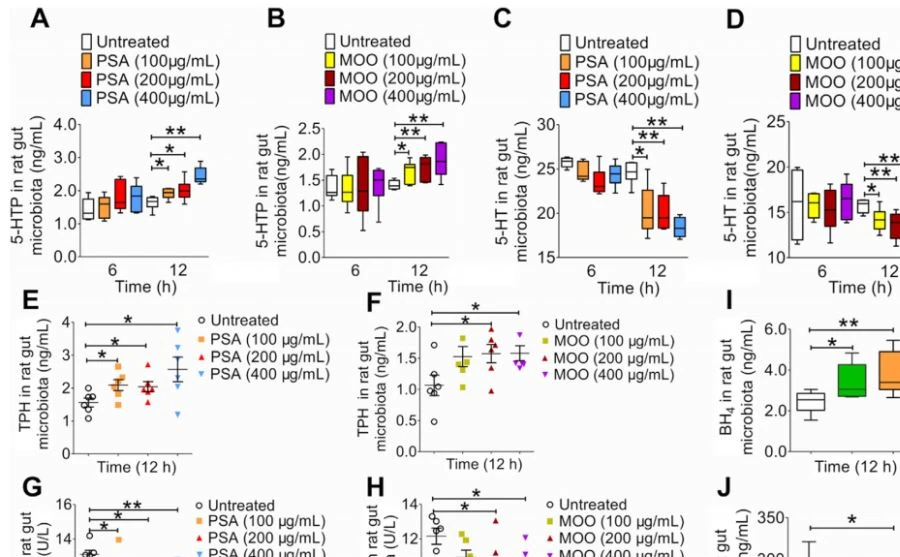
1. MOO can increase the level of 5-HTP in the intestinal flora and reduce the production of 5-HT in vitro.

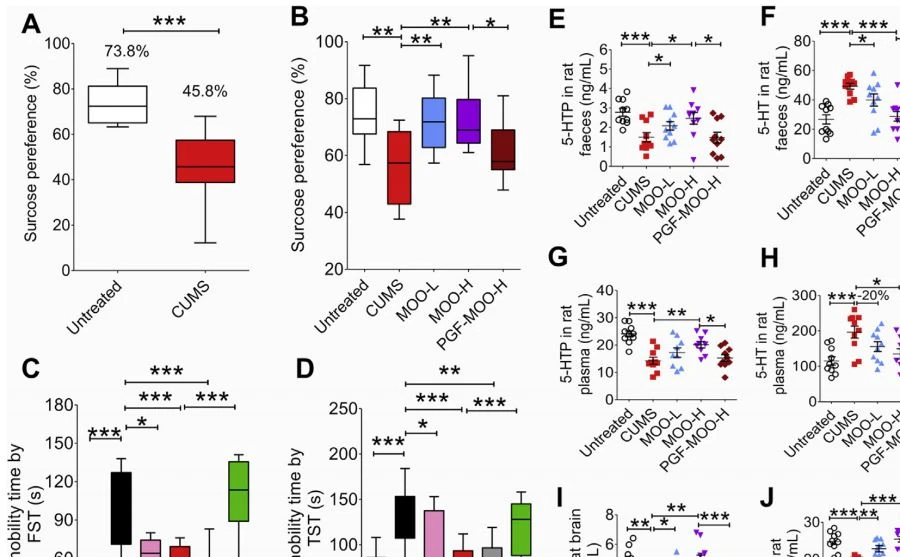
2. MOO treatment improved depressive behavior and altered 5-HTP and 5-HT levels in feces, blood, and brain in CUMS rats and reserpine-induced mice.
3. MOO alters TPH, BH4, VB6 levels and 5-HTPDC activity in vitro.

4. Screening of the antidepressant effect of MOO from trisaccharide to non-monosaccharide in vitro, and verification of the enzymatic function of TPH and 5-HTPDC in intestinal flora.

5.PSA showed similar effects on gut microbiota in vitro compared to MOO.
6. Possible link between MOO and specific strains of gut microbiota in depression.

Taken together, MOO exerts antidepressant effects by regulating 5-HT synthesis in the gut microbiota. MOO firstly increased the level of TPH, thereby promoting the conversion of Trp to 5-HTP; secondly, MOO decreased the activity of 5-HTPDC in the intestinal flora, thereby inhibiting the translation of 5-HTP to 5-HT. The results showed that the synthesis of 5-HTP in the intestinal flora increased and the metabolism of 5-HT decreased, thereby significantly increasing the absorption of 5-HTP in the blood. Since 5-HT in the blood, but 5-HTP cannot enter the brain through the blood-brain barrier37,63, the increased 5-HTP in the blood may enter the brain, further promote the production of 5-HT, and exert an antidepressant effect.
