




Apple cider vinegar powder is a fermented liquid converted into a free-flowing solid, and the conversion is where the product is actually defined. This page sets out how the powder is made, what the carrier does to the label, which numbers on the certificate decide behaviour on a production line, and where the dry format is the better engineering choice than the liquid.
What the Powder Is, and What It Is Not
Apple cider vinegar is the product of a two-stage fermentation: yeast converts the sugars of apple juice to ethanol, and acetic acid bacteria then oxidise that ethanol to acetic acid. The finished liquid is roughly 5–6% acetic acid with residual sugars, malic acid from the apple, amino acids and a small polyphenol fraction.
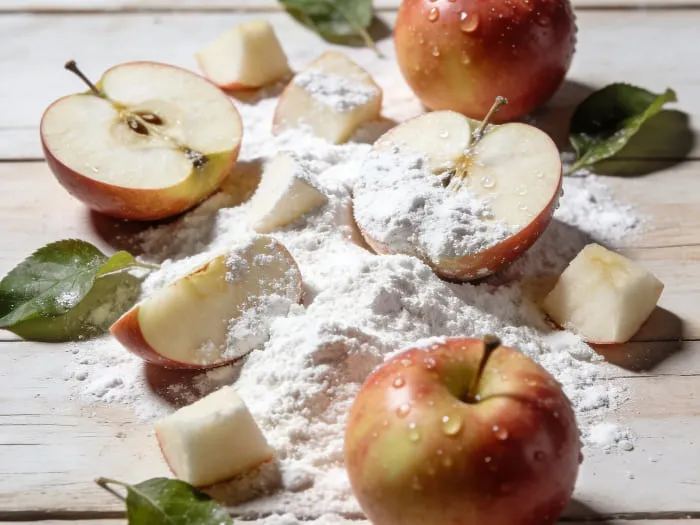
Apple cider vinegar powder is that liquid made solid. It is not dried vinegar in the literal sense - evaporating the water would take the volatile acetic acid with it - so the vinegar is concentrated, blended with a carrier and dried. The powder that leaves the tower is therefore a formulation, and its acidity per gram is a decision rather than a constant.
The Carrier Decides the Label
Maltodextrin is the default carrier because it is cheap, neutral and dries cleanly. Acacia fibre and several starches are used where the customer's label has to stay short or where a fibre claim is already on the pack. The carrier is a declared ingredient: at a 1–3% acidity grade the carrier can be the larger part of the mass, which is why two powders with the same appearance can carry very different acid loads.
| Item | Typical value |
| Product name | Apple Cider Vinegar Powder |
| Total acidity (as acetic acid) | 1% – 3% for carrier-blended grades; up to 10% for concentrated grades, to order |
| Carrier | Maltodextrin by default; acacia fibre or starch on request |
| Appearance | Off-white to pale cream powder |
| Solubility | Dispersible in water; clumping possible in cold water at high dosage |
| Aroma | Vinegar character, intensity follows the acid load |
| Moisture | Controlled to specification |
| Packaging | 25 kg fiber drum with food-grade inner liner |
Spray Drying or Freeze Drying
Spray drying is the industrial route. The concentrated vinegar and carrier emulsion is atomised into a hot air stream; the water flashes off in seconds and the particle forms as a hollow sphere. It is fast, continuous and cheap per kilogram, and the short residence time limits heat damage to the acid.
Freeze drying removes water by sublimation instead. It preserves volatiles better and produces a lighter, more porous powder that reconstitutes quickly, but it is a batch process with a much higher cost per kilogram. For a carrier-blended grade at single-digit acidity, spray drying is normally the correct answer; freeze drying earns its cost only where the aroma is the point.

What the Certificate of Analysis Should Show
- Total acidity as acetic acid - the acid load per gram, which is the number the label claim rests on
- Carrier identity and ratio - a declared ingredient, not an internal detail
- Moisture and water activity - the best predictors of caking in the bag and in the hopper
- Particle size and bulk density - whether the powder will run on an existing dosing line
- Heavy metals and microbiological panel - the baseline for any food or supplement application
Two habits avoid most quality disputes. Ask for the acidity figure and the carrier ratio on the same document, because quoting one without the other describes half the product. And keep a retained sample from each lot: the powder is hygroscopic, so a caking complaint six months later is only resolvable against the material as it was delivered.
Where the Dry Format Earns Its Place
The powder solves two problems that liquid vinegar creates on a production line: it adds no water to a dry blend, and it needs no acid-resistant dosing equipment. That is why it appears in seasoning and dry-rub blends, dressing and sauce mixes, effervescent and stick-pack beverages, capsule and tablet blends, and bakery or confectionery applications where a controlled acid note is part of the flavour profile.
Storage and Handling
Keep drums sealed, store below 25 °C away from strong odours, and close the liner immediately after weighing. Exposed to humid air the carrier picks up water, the powder cakes and the flow is gone; under sealed, dry conditions the acid level is stable and the shelf life stated on the label applies.
Frequently Asked Questions
Q: Is the powder simply dried vinegar?
No. Vinegar cannot be dried without losing acetic acid, so the liquid is concentrated, carried on a drying aid and then dried. The finished acidity is set by formulation and confirmed by analysis.
Q: Why does the specification give a range rather than one number?
Because acidity is a formulation parameter. A 3% grade and a 10% grade are different products for different dose sizes, and the batch CoA states the value actually delivered.
Q: Can the carrier be changed?
Yes - maltodextrin is the default, and acacia fibre or a starch carrier can be produced to order where the label declaration has to stay clean.
Q: How should the powder be stored after opening?
Reseal the liner, keep the drum closed and store dry below 25 °C. The powder is hygroscopic and its flow behaviour degrades before any analytical change appears.
Request a Quotation
Tell us your target specification, order quantity and destination - our export team will respond with a quotation, an evaluation sample plan and the full documentation pack (CoA, MSDS, specification sheet, allergen statement).
WhatsApp: +86 198 9098 2054 Phone: +86 135 7218 6576 | E-mail: liu@wellgreenxa.com Or use the inquiry form below - send it straight to the form. |
Related Reading
This page describes an industrial botanical ingredient for business-to-business use. It is not intended to diagnose, treat, cure or prevent any disease, and is not intended for direct consumer use.
