


This note summarises a published animal study on palm fruit bioactives and sets out the study design and the endpoints measured, so that a formulator can judge how much weight the findings can carry. It is a laboratory-research summary, not a product claim.
The material
Palm fruit bioactives (PFB) are the water-soluble phenolic fraction of the oil palm fruit, Elaeis guineensis. The fraction carries phenolic acids and flavonoids and is supplied as a standardised powder, typically specified as total phenolics expressed in gallic acid equivalents (GAE) with the assay method stated.
Study design
The work was conducted by a research collaboration spanning MIT, Brandeis University and a palm oil research group, and published in Scientific Reports. The design was as follows:
| Parameter | Detail |
| Model | Male Nile grass rat, weaned at 3 weeks |
| Total animals | 39 (21 control, 18 experimental) |
| Diet | Fibre-free, high-carbohydrate; macronutrient ratio 60:20:20 |
| Intervention | 10% PFB added to the same diet, at 4.7 mg GAE/g diet |
| Duration | 8 weeks |
| Endpoint measures | Body weight, fasting glucose, oral glucose tolerance test (OGTT), organ weights (liver, kidney, cecum, adipose depots), cecal weight, body length |
What was reported
Animals on the fibre-free high-carbohydrate diet fell into two groups: those that developed a diet-induced metabolic phenotype and those that did not. In the control group, 12 of 21 animals (57%) reached the defined endpoint. In the PFB-supplemented group, 6 of 18 (33%) did. The authors reported this as an approximately 45% reduction in incidence in this model.
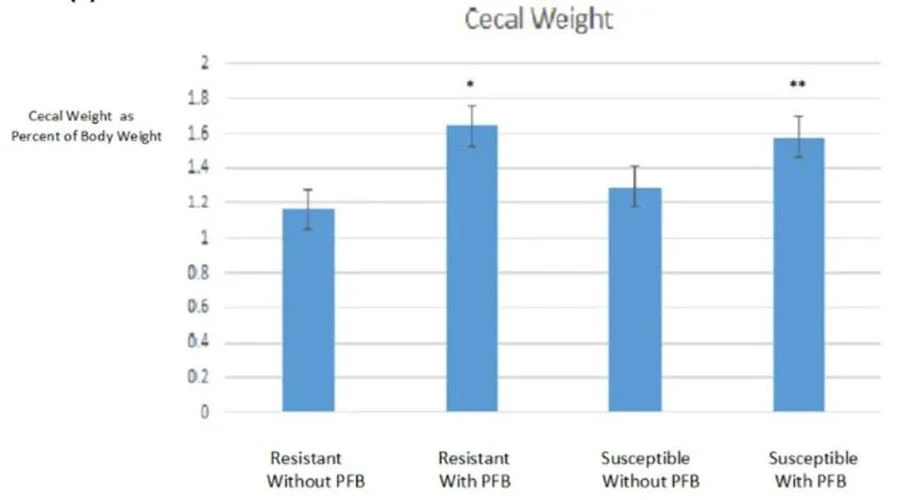
Alongside the incidence figure, the paper reported differences in body weight over the eight weeks, in the glucose measurements set out above, and in organ weights normalised to body weight. Cecal weight - one of the measured endpoints, reflecting the gut compartment - was higher in the supplemented animals. The figure reproduced on this page is that endpoint as reported in the study.
How to read this
Four qualifications should travel with the numbers. The study is in a rodent model, not in humans, and animal-model findings are hypotheses for human research rather than conclusions about people. The Nile grass rat is chosen for this work precisely because it develops the metabolic phenotype on a defined diet, which makes it a sensitive model - and sensitivity cuts both ways. The supplemented group received PFB as 10% of the diet, a high inclusion level for a human food format, so the dose does not translate directly. And a changed incidence rate in a rodent population is not a permitted label claim in any major market; claims of that kind require authorisation that no such ingredient holds for this endpoint.
What the study contributes usefully is a documented dose-response framework and a set of measured endpoints in a defined model - the basis for designing further work, and for a buyer to judge whether an ingredient's technical story stands on anything more than anecdote.
Ingredient specification
| Item | Value |
| Botanical name | Elaeis guineensis |
| Part used | Fruit |
| Marker | Total phenolics (gallic acid equivalents); standardised grades available |
| Test method | UV / HPLC (method stated with each figure) |
| Appearance | Red-brown to brown fine powder |
| Solubility | Water-dispersible |
| Grade | Food grade |
| Packaging | 25 kg fibre drum with food-grade inner liner |
Standard market grades are available, and custom specifications can be produced to order. Exact parameters are confirmed per order and stated in the batch Certificate of Analysis.
Applications
- Solid drinks and instant beverage bases
- Capsules, tablets and sachets
- Functional food and confectionery
- Nutritional blends
Enquiries
Wellgreen Technology Co., Ltd. specialises in plant extraction for the food and nutritional industries. Technical data packs, specification sheets and evaluation samples are available for qualified enquiries; contact us at liu@wellgreenxa.com with the target phenolic content and application.
This page describes an industrial botanical ingredient and summarises published laboratory research for business-to-business use. It is not intended to diagnose, treat, cure or prevent any disease, and is not intended for direct consumer use.
