


Black mulberry (Morus nigra) is one of the fruit-bearing species of the genus Morus, and is cultivated in China for both food and ingredient use. The fruit is the part normally harvested and dried, and it is the material behind most of the phytochemical work published on the species.
Phytochemistry
Black mulberry fruit is a source of flavonoids, alkaloids, polyphenols and benzofuran derivatives. The genus is also known for iminosugars and for the Diels-Alder adducts (moracins and related structures) that characterise the Moraceae. This combination is the reason the species is studied both as a food ingredient and as a source of reference compounds.
What the research looks like
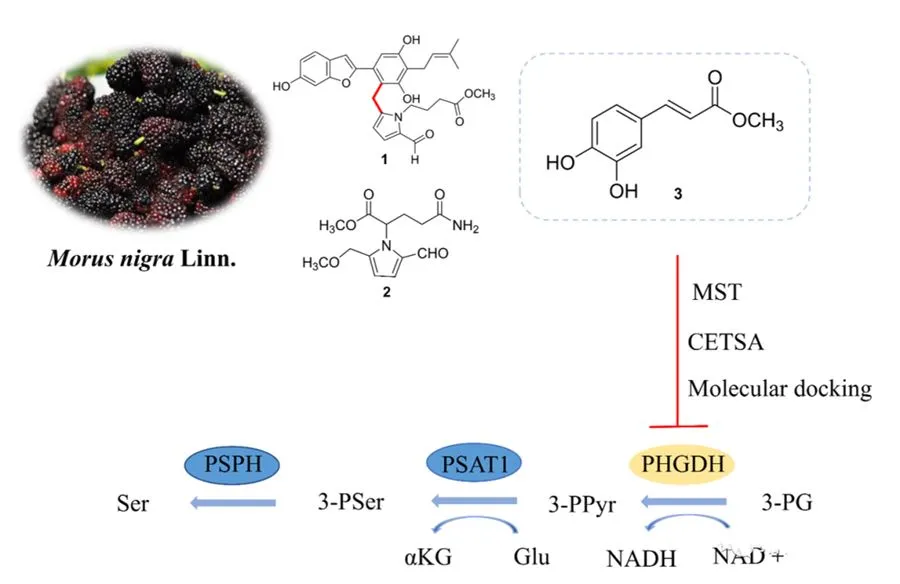
A published phytochemical study on black mulberry fruit isolated twenty compounds, two of which were reported as new: moranigrine A and morusamine. Moranigrine A is a rare structure combining a pyrrole-2-aldehyde unit with a 2-arylbenzofuran. The same study screened the isolated compounds against 3-phosphoglycerate dehydrogenase (PHGDH), an enzyme of serine metabolism that has attracted interest as a research target in oncology drug discovery because of its role in the metabolic reprogramming of proliferating cells.
Among the compounds screened, methyl caffeate showed measurable inhibition of PHGDH. Enzyme-kinetics work characterised it as a non-competitive inhibitor relative to the substrate 3-phosphoglycerate, acting in a concentration-dependent manner; binding studies indicated interaction with an allosteric pocket rather than the active site. Cell-culture and xenograft experiments were used by the authors to examine the compound further, and they proposed methyl caffeate as a lead structure for further research on PHGDH-targeting compounds.
Reading this correctly
These are compound-level research findings. They describe how isolated molecules behave in defined experimental systems; they do not establish an effect of black mulberry fruit, black mulberry powder or any finished product in humans, and they do not support a disease-related claim on a label. Buyers developing a mulberry ingredient should treat the published literature as a source of formulation and sourcing direction, and clear any intended claim against the rules of the destination market before writing copy.
Sourcing considerations
Commercially, black mulberry is supplied as whole dried fruit, fruit powder and standardised extracts. The parameters that determine whether a grade suits a given formulation are the plant part used, the extraction solvent, the standardisation marker and its assay method, the particle size, and whether a batch-specific Certificate of Analysis is supplied with each lot. Buyer specifications should state the marker compound explicitly, because "mulberry extract" alone does not identify what is being measured.
We supply mulberry fruit extract, mulberry powder and mulberry leaf extract. For specifications, pricing and lead time, contact us at liu@wellgreenxa.com.
This page describes an industrial botanical ingredient for business-to-business use. It is not intended to diagnose, treat, cure or prevent any disease, and is not intended for direct consumer use.
