




Yucca extract is one of the few feed ingredients bought for what it does to the air in a building rather than to the animal. This page answers the questions buyers send us most often - grades, inclusion ranges, storage, documents - and sets out where the category is heading as ammonia rules tighten.
What the Product Actually Is
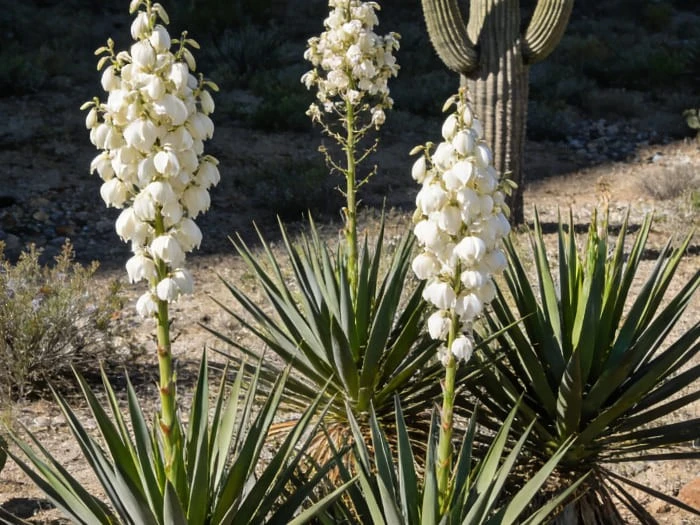
Yucca extract is a water–alcohol extract of the trunk and stem of Yucca schidigera, a slow-growing desert plant of the Agavaceae native to the Mojave desert and northern Mexico. The extracted material is spray-dried to a light brown powder and sold on its steroidal saponin content, with a polysaccharide and resin fraction carried along with it.
The saponins are the commercial centre of the grade. They are surface-active molecules - a sugar chain attached to a steroidal aglycone - and that structure is why the powder foams in water, why it wets surfaces, and why it is used in applications where ammonia and other volatile nitrogen compounds have to be managed. Almost every question a buyer sends comes back to how much saponin the batch carries and by which method that figure was obtained.
Grades and How Saponin Content Is Quoted
Saponin content is quoted either as a percentage by a gravimetric or spectrophotometric method, or as a figure derived from the foaming behaviour of a standard solution. The two are not interchangeable: a 30% grade on one method can read differently under another, so a quotation that gives a percentage without the method is only half a specification.
Standard market grades are available, and custom specifications can be produced to order. Exact parameters are confirmed per order and stated in the batch Certificate of Analysis.
| Item | Value |
| Product name | Yucca Extract Powder |
| Botanical source | Yucca schidigera |
| Plant part | Trunk and stem |
| Marker | Steroidal saponins, expressed on a stated method |
| Common commercial grades | 10%, 30% and 50% saponin, to order |
| Appearance | Light brown to brown powder |
| Solubility | Dispersible in water; a foam forms on agitation |
| Packaging | 25 kg fiber drum with food-grade inner liner |
| MOQ | MOQ is confirmed per order |
| Documents | CoA, MSDS, specification sheet, allergen statement |
Inclusion Ranges Used in Commercial Feed and Pond Applications
The ranges below are the ones quoted in commercial practice for yucca extract at a 30% saponin grade. They are starting points for a formulation trial rather than a fixed dose: the working inclusion follows the saponin content of the batch, the species, the housing system and the ammonia load the site is carrying.
| Species / application | Reported inclusion range |
| Poultry and broilers | about 100–200 g per tonne of complete feed |
| Swine | about 150–300 g per tonne of complete feed |
| Dairy cattle | about 200–500 g per tonne of complete feed |
| Aquaculture | about 0.5–1.0 g per litre of pond water |
| Pet food | about 100–500 g per tonne |
A 10% grade carries a third of the saponin of a 30% grade, so the inclusion has to be recalculated on the saponin basis rather than copied across grades. This is the single most common costing error we see when a buyer switches supplier.
Ammonia Control: What the Mechanism Covers
Urea in urine and in slurry is hydrolysed by urease to ammonia and carbon dioxide. That reaction is what puts ammonia into the air of a livestock building, and its rate depends on temperature, pH and the urease activity present in the litter or slurry. Yucca saponins act on two points in that chain: they reduce urease activity, and their surface activity binds ammonia and ammonium ions, lowering the share that volatilises.
What the ingredient does not do is substitute for ventilation, stocking density or slurry management. Those remain the primary controls, and a feed-side measure is judged alongside them - which is why the sites that get the most out of yucca extract are the ones that measure ammonia at fixed points before and after a change, rather than relying on how the building smells.
Handling, Storage and Shelf Life
- Sealed original drum, below 25 °C, dry and out of direct light; the powder is hygroscopic once the liner is opened
- Dust control during weighing - local extraction and respiratory protection are standard practice for any powdered extract
- Commercial material is typically stated at two to three years in the unopened drum; an opened drum is resealed and used within the batch window stated on its CoA
- Liquid grades need a preservative system and a sealed tank; they are shorter-lived once opened
Practical Questions Buyers Ask
Q: Can yucca extract be used in pelleted feed?
Yes. Where the inclusion is small the material is normally added through a premix so that it is distributed evenly through the batch; a post-pelleting liquid addition is the alternative for high-throughput lines.
Q: Should I buy powder or liquid?
Powder for premix, dry blends and products that will be stored; liquid where it is dosed into a wet process such as a slurry tank or a water line. Both are made from the same extract, so the saponin figure is the basis for comparison, not the physical form.
Q: How is performance checked on site?
By ammonia measurement at fixed points and times of day, together with litter moisture and feed intake records. Changes are read over weeks of consistent inclusion, not over days, and a control house makes the comparison meaningful.
Q: Are there restrictions on use?
Feed-additive registration differs by market, and the listing is confirmed by the buyer's regulatory team for the destination country. We supply the CoA, MSDS, specification sheet, allergen statement and traceability records that the review usually asks for.
Q: What ships with a batch?
A batch-specific Certificate of Analysis covering saponin content and its method, moisture, heavy metals and the microbiological panel, plus MSDS, specification sheet and allergen statement. BSE/TSE and GMO statements are issued on request.
Where the Category Is Heading
Emissions rules are getting tighter
Several markets now regulate ammonia from livestock buildings directly, and a feed-side measure is one of the few levers a producer can pull without rebuilding housing. That is the main structural reason demand for saponin-based ingredients has moved from a niche additive to a line item in nutrition programmes.
Inclusion by measurement rather than by habit
Phase feeding and on-farm ammonia monitoring make it practical to vary inclusion by building and by season instead of holding one herd-wide rate. Suppliers are being asked for saponin content per batch precisely because the calculation has to be redone when the grade changes.
Documentation as a purchasing criterion
Buyers increasingly ask which method produced the saponin figure, what the contaminant panel covers, and whether the plant part is stated. A quotation that answers those three questions is comparable; one that gives a percentage alone is not.
Clean-label reformulation
Where synthetic additives face labelling pressure, plant-derived actives are reviewed as replacements. The practical constraint is the odour of the extract itself - a strong, sweet–smoky, molasses-like note - which is why deodorised grades exist and why the aroma should be settled before a batch is made.
Summary for B2B Buyers
Three questions separate a real specification from a label: the saponin percentage and the method behind it, the species and plant part, and whether the grade is straight extract or carrier-blended. Answer those, recalculate the inclusion on the saponin basis, and run a measured trial on one house before scaling.
Request a Quotation
Tell us your target specification, order quantity and destination - our export team will respond with a quotation, an evaluation sample plan and the full documentation pack (CoA, MSDS, specification sheet, allergen statement).
WhatsApp: +86 198 9098 2054 Phone: +86 135 7218 6576 | E-mail: liu@wellgreenxa.com Or use the inquiry form below - send it straight to the form. |
Related Reading
This page describes an industrial botanical ingredient for business-to-business use. It is not intended to diagnose, treat, cure or prevent any disease, and is not intended for direct consumer use.
