




Yucca extract powder is used in livestock production for one measured reason: it reduces ammonia in the housing environment. This page covers the chemistry behind that effect, the commercial grades and forms, how inclusion is actually set, and how to run a trial that produces a defensible answer.
Why Yucca Is Used in Livestock Production
The air in a livestock house is dominated by ammonia, and ammonia comes from the urease reaction: urease-producing bacteria in the litter split urea from the slurry into ammonia and carbon dioxide. The higher the pH and the wetter the litter, the faster the ammonia is released, and the more of it reaches the birds or animals and the workers.
Yucca extract is used in that environment because its steroidal saponins act on two points of the same problem: they inhibit urease activity, slowing the conversion of urea, and their surface activity binds ammonia in solution. The effect is on the housing environment and on litter management rather than on the animal directly, which is why the material is normally specified in the feed or the water and evaluated on measured ammonia concentration.
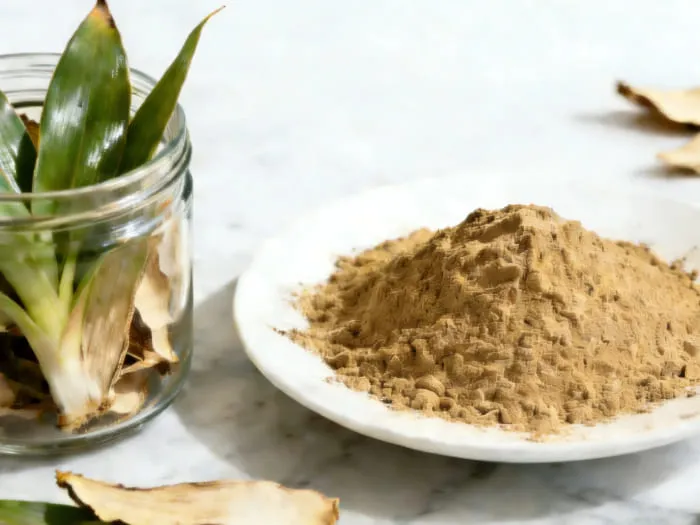
The Commercial Forms
- Spray-dried powder - the standard feed-mill input; measured into a premix and diluted through the ration
- Liquid concentrate - dosed through the drinking line, where a water-soluble grade and a stable dilution are required
- Carrier-blended powder - a lower-saponin grade used where the inclusion rate is very small and accuracy of weighing matters
Saponin content is the number that sets the price and the dose. Grades are commonly quoted at 10%, 30% and 50% saponin and the analytical method must be stated beside the figure, because gravimetric and spectrophotometric results are not interchangeable.
Inclusion and How It Is Set
| Item | Typical value |
| Product name | Yucca Extract Powder (feed grade) |
| Botanical source | Yucca schidigera Roezl ex Ortgies |
| Plant part | Trunk and stem |
| Marker | Steroidal saponins, method stated |
| Common grades | 10%, 30%, 50% saponin |
| Appearance | Light brown to brown powder |
| Solubility | Dispersible in water; foams on agitation |
| Packaging | 25 kg fiber drum with food-grade inner liner |
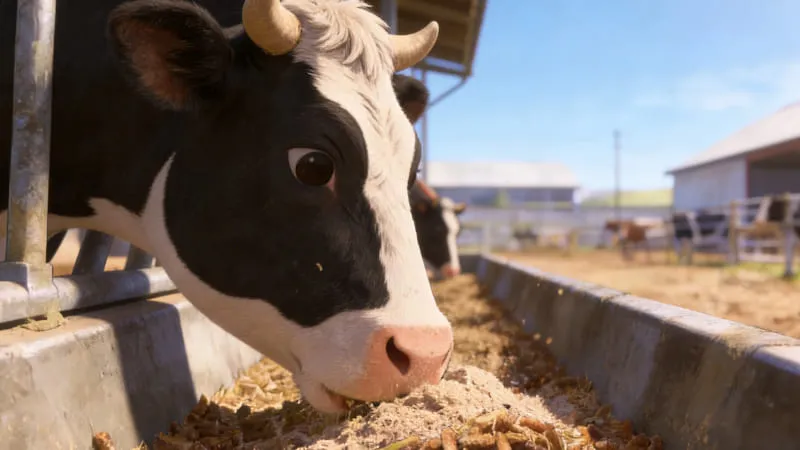
There is no universal inclusion rate. The dose follows from the saponin content of the batch, the species, the housing system and the ammonia load being managed, and it is set by the customer's nutritionist against local registration rules. We quote against a target inclusion and state the saponin basis that the calculation starts from, rather than publishing a single figure that would not survive contact with a real barn.
Measuring Whether It Works
The honest way to evaluate yucca extract in a livestock operation is to measure ammonia where the animals live. A trial that records atmospheric ammonia at a fixed height and time of day, litter moisture and litter pH, before and after inclusion, produces a defensible answer; a trial that records only feed intake usually produces noise. Because the effect depends on the saponin dose actually delivered, the batch assay belongs in the trial record.
Regulatory and Documentation Notes
Feed additives are regulated by destination market, and the permitted claims differ between them. The documentation pack therefore carries the batch Certificate of Analysis with saponin content and method, heavy metals, microbiological panel, MSDS, specification sheet, allergen statement and traceability records, so that the registration file can be assembled without another round of correspondence.
Two practical points. The material has a strong characteristic odour, which is normal and comes from the same plant matrix as the saponins. And the powder is hygroscopic once the drum is open, so a feed mill that weighs it in a humid room should expect caking at the bottom of the bag before it sees any assay change.
Frequently Asked Questions
Q: Does yucca extract work in the animal or in the house?
The measured effect is on the housing environment: reduced urease activity and bound ammonia. That is why trials measure atmospheric ammonia and litter conditions rather than animal performance alone.
Q: Which grade should a feed mill specify?
The grade follows from the inclusion rate. A 50% saponin grade keeps the inclusion small; a 10% grade is easier to distribute evenly through a premix. Both are quoted on the saponin basis.
Q: Is the liquid form equivalent to the powder?
They are made from the same extract, but the liquid carries water and needs a preservative system and a sealed tank. For a dry premix the powder is the practical choice.
Q: What documents are needed for registration?
A batch CoA with saponin content and method, heavy metals and microbiology, plus MSDS, specification sheet, allergen statement and traceability records. Requirements vary by destination market.
Request a Quotation
Tell us your target specification, order quantity and destination - our export team will respond with a quotation, an evaluation sample plan and the full documentation pack (CoA, MSDS, specification sheet, allergen statement).
WhatsApp: +86 198 9098 2054 Phone: +86 135 7218 6576 | E-mail: liu@wellgreenxa.com Or use the inquiry form below - send it straight to the form. |
Related Reading
This page describes an industrial botanical ingredient for business-to-business use. It is not intended to diagnose, treat, cure or prevent any disease, and is not intended for direct consumer use.
