




For B2B formulators and procurement professionals, liposomal vitamin C has emerged as a premier technical solution to one of the industry's most persistent formulation challenges-the oxidative instability of ascorbic acid. But how much of the oxidation problem does liposomal vitamin C actually solve?
1. The Vitamin C Stability Problem: Why Conventional Ascorbic Acid Fails in Formulations
Vitamin C, or ascorbic acid, is famously unstable in industrial applications. In its free form, it degrades rapidly when exposed to oxygen, light, heat, moisture, and trace metals. This is not just a minor formulation nuisance-it is a fundamental limitation that directly impacts product shelf life, real-time label claims, and ultimate consumer trust. This is precisely why liposomal vitamin C has drawn increasing attention from B2B suppliers and formulators alike.
1.1 The Oxidation Mechanism
Ascorbic acid undergoes molecular degradation through two primary pathways:
- Chemical oxidation is catalyzed by metallic ions such as copper (Cu²⁺) and iron (Fe³⁺) in the presence of dissolved oxygen, operating at a strictly pH-dependent rate.
- Enzymatic oxidation occurs via ascorbate oxidase, which is naturally present in many plant-derived raw materials.
1.2 Key Environmental Degradation Factors
The degradation process is accelerated by multiple environmental variables:
| Factor | Impact on Vitamin C Stability |
|---|---|
| Oxygen exposure | Primary chemical driver of oxidative breakdown |
| Light radiation | UV wavelengths accelerate molecular degradation |
| Elevated temperature | Especially during thermal processing and long-term storage |
| Ambient moisture | Promotes deliquescence and subsequent chemical instability |
| Trace metal ions | Minute amounts catalyze rapid oxidation reactions |
| Environmental pH | Stability decreases as pH rises above 3.5 |
1.3 The Real Cost of Instability for Brands
For B2B buyers, vitamin C instability translates into concrete commercial liabilities:
- Shelf-life limitations – Finished products lose physiological potency before reaching consumers, forcing shorter expiration dates and accelerating inventory turnover costs.
- Label claim risks – If the active vitamin C content falls below declared values during stability testing, brands face regulatory non-compliance risks and potential product recalls.
- Formulation restrictions – Conventional vitamin C requires highly acidic conditions (pH below 3.5) to remain reasonably stable in aqueous formats, severely limiting application flexibility for premium blends.
- Visual deterioration – As ascorbic acid degrades, it undergoes complex non-enzymatic browning reactions, which may lead to visible quality changes such as severe discoloration or off-odor formation.
2. Liposomal Encapsulation: How the Technology Protects Vitamin C
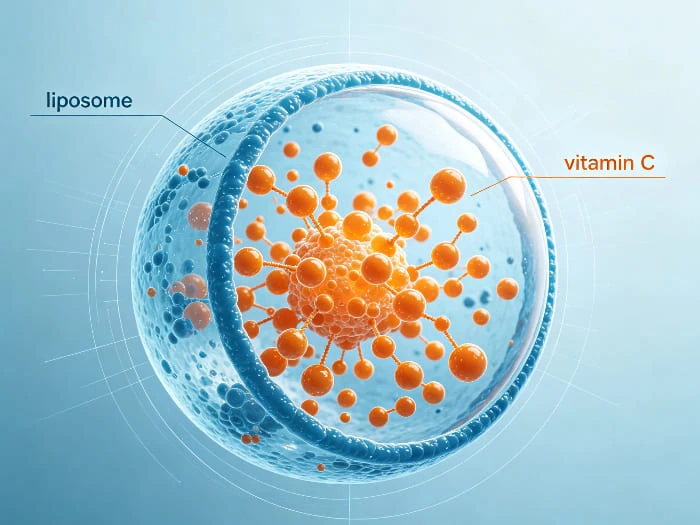
Liposomes are microscopic vesicles composed of core phospholipid bilayers that encapsulate an aqueous core containing the active molecule. This advanced structure-which structurally mimics natural cell membranes-creates a protective microenvironment for the encapsulated active ingredient. When applied to vitamin C, the result is liposomal vitamin C, a delivery system designed to overcome the inherent fragility of ascorbic acid.
2.1 The Protection Mechanism
When vitamin C is successfully encapsulated within optimized liposomes, several protective effects occur simultaneously:
Reduced exposure – The dense phospholipid bilayer reduces exposure to oxygen and aqueous pro-oxidant environments in the surrounding formulation.
Microenvironment mitigation – The interior core of the liposome provides improved stability across a wider pH range, allowing developers more flexibility when formulating finished blends.
Oxidation resistance – Liposomal encapsulation significantly improves storage retention profiles. Research indicates that liposomal vitamin C retained significantly higher vitamin C content compared to non-encapsulated controls after 60 days of storage.
Thermal protection – Differential scanning calorimetry analysis shows that encapsulated vitamin C exhibits superior thermal stability relative to standard aqueous vitamin C solutions-a critical advantage for products undergoing pasteurization or heat processing.
2.2 What the Science Indicates
Recent process engineering research has quantified these protective attributes:
A 2024 study documented that dynamic high-pressure microfluidization techniques can achieve a verified encapsulation efficiency exceeding 80% for liposomal vitamin C, contributing to improved initial protection.
Another study evaluating tailored saturated phosphatidylcholine liposomes found that liposomal encapsulation substantially improves the physicochemical stability of both ascorbic acid and calcium ascorbate, concluding that the approach "has attracted considerable attention as a primary strategy to improve both the stability and delivery efficiency of delicate vitamins."
In functional food applications, liposomes have demonstrated a reliable protective effect on the antioxidant retention of vitamins before and after pasteurization, reinforcing the value of liposomal vitamin C in real-world manufacturing.
3. How Much of the Oxidation Problem Does Liposomal Vitamin C Actually Fix?
The honest answer: a substantial portion, but not all of it. High encapsulation efficiency (exceeding 80%) contributes to improved protection, but long-term stability ultimately depends on the total formulation design and exact lipid composition. Understanding both the strengths and limitations of liposomal vitamin C is essential for formulators and procurement teams.
3.1 Stability Factor Comparison
| Stability Factor | Conventional Vitamin C | Liposomal Vitamin C |
|---|---|---|
| Oxygen protection | Poor – rapid oxidation | Good – phospholipid barrier |
| Light stability | Poor – UV accelerates degradation | Moderate – partial protection |
| Thermal stability | Poor – degrades with heat | Improved – better heat tolerance |
| pH flexibility | Limited – requires pH below 3.5 | Enhanced – wider working range |
| Metal ion protection | Poor – catalyzed oxidation | Improved – partially mitigated |
| Observed stability | Weeks to months | Extended – >60 days retention |
3.2 What Liposomal Vitamin C Cannot Do
While liposomal vitamin C offers significant advantages, it is not a universal panacea:
- Eliminate degradation entirely – Even optimized systems may experience gradual leakage of encapsulated vitamin C over time, especially under suboptimal storage conditions.
- Compensate for poor manufacturing practices – If the liposomal vesicles are subjected to excessive shear or incompatible surfactants during manufacturing, the protective membrane is compromised.
- Automatically translate from lab to commercial scale – Performance differences between laboratory-scale and commercial-scale production should always be considered.
- Replace proper storage baselines – Even liposomal vitamin C performs best under appropriate storage conditions (cool, dry, protected from light).
4. B2B Value Proposition: Why Liposomal Vitamin C Matters for Your Business
4.1 Formulation Freedom
With liposomal vitamin C, you can formulate at wider pH values without sacrificing active stability. This opens up new product categories:
Near-neutral pH functional beverages
Multi-ingredient combination supplements with pH-sensitive actives
Formulations with a reduced need for heavy, acidic flavor masking
4.2 Extended Shelf Life
The improved molecular stability translates directly into longer commercial shelf life. With high baseline encapsulation efficiency and demonstrated stability over extended storage cycles, brands can confidently offer products with extended expiration dates-a major competitive advantage.
4.3 Regulatory Confidence
When you can demonstrate that your liposomal vitamin C remains stable and within specification throughout the product lifecycle, you minimize the risk of label claim violations.
4.4 Clean Label Compatibility
Premium liposomal vitamin C formulations can be produced using food-grade, non-GMO phospholipids, supporting clean-label positioning without relying on synthetic stabilizers.

5. What B2B Buyers Should Evaluate in a Liposomal Vitamin C Supplier
When auditing suppliers of liposomal vitamin C, consider these core technical criteria:
| Evaluation Criteria | What to Look For |
|---|---|
| Encapsulation efficiency & leakage rates | Verified >80% initially; request leakage data over time |
| Particle size distribution | Smaller, more uniform liposomes provide superior stability and bioavailability |
| Stability documentation | Comprehensive studies under accelerated and real-time conditions |
| Production scalability | Consistent vesicle integrity at commercial scale |
| Regulatory & quality dossiers | Full COA, manufacturing licenses, and quality certifications |
| Technical formulation support | Direct support to optimize incorporation without damaging vesicles |
6. Conclusion
Liposomal vitamin C directly addresses the core instability challenges of ascorbic acid-oxidation, thermal breakdown, and pH sensitivity-by creating a protective microenvironment that extends stability and opens up formulation flexibility. It does not eliminate degradation entirely, but it successfully transforms vitamin C from a notoriously difficult ingredient into a highly reliable formulation component.
For B2B buyers, liposomal vitamin C delivers:
- Extended shelf life and reduced inventory risk
- Enhanced formulation freedom across diverse pH ranges
- Regulatory confidence through documented stability
- Cleaner product labels without synthetic stabilizers
- More predictable supply chains and lower total cost
When sourced from a qualified supplier capable of maintaining vesicle integrity from lab to large scale, liposomal vitamin C offers a practical, scientifically validated solution to one of the nutrition industry's most persistent challenges.
Ready to explore liposomal vitamin C for your formulations?
- Request technical samples – Test stability and leakage performance in your specific product application.
- Get the technical data package – Access full specifications, detailed stability data, and scale-up documentation.
- Discuss custom specifications – Explore custom particle size configurations, specific encapsulation efficiencies, or formulation support.
- Schedule a technical consultation – Speak with our formulation scientists about managing processing shear and vesicle integrity.
Minimum Order Quantity (MOQ), lead time, and bulk pricing are available upon request. For technical support, formulation consultation, and bulk quotations, contact our team.
References
- "Enhanced Stability of Oral Vitamin C Delivery: A Novel Large-Scale Method for Liposomes Production and Encapsulation through Dynamic High-Pressure Microfluidization." PMC, 2024.
- "Tailored saturated phosphatidylcholine liposomes enhance the physicochemical stability and intestinal bioavailability of ascorbic acid and calcium ascorbate." ScienceDirect, 2026.
- "Preparation of VC nanoliposomes by high-pressure homogenization: Process optimization and evaluation of efficacy, transdermal absorption, and stability." PMC, 2024.
- "Effect of liposomal formulation of ascorbic acid on corneal permeability." PMC, 2023.
- "Liposomes as vehicles for vitamins E and C: An alternative to fortify orange juice and offer vitamin C protection after heat treatment." ScienceDirect, 2011.
- Kabasakalis V, et al. "Modeling the effect of headspace oxygen level on the degradation of vitamin C in a model fruit juice." ResearchPortal.
- Yan et al. "Kinetics of Vitamin C degradation and browning index of enriched heat-treated yogurt milk." 2021.
