




Thaumatin structure represents a pinnacle of natural biochemical engineering, providing food scientists and R&D formulators with a heat-stable, protein-based solution that achieves up to 3,000 times the sweetness of sucrose while simultaneously functioning as a potent flavor modifier. For B2B procurement and product development teams, the primary challenge in sugar reduction is not merely replacing sweetness, but managing the complex sensory hurdles of bitterness, lingering aftertastes, and the loss of mouthfeel. Thaumatin addresses these pain points through a unique molecular architecture that survives the rigors of industrial food processing, offering a "Clean Label" alternative that aligns with global regulatory shifts toward natural ingredients.
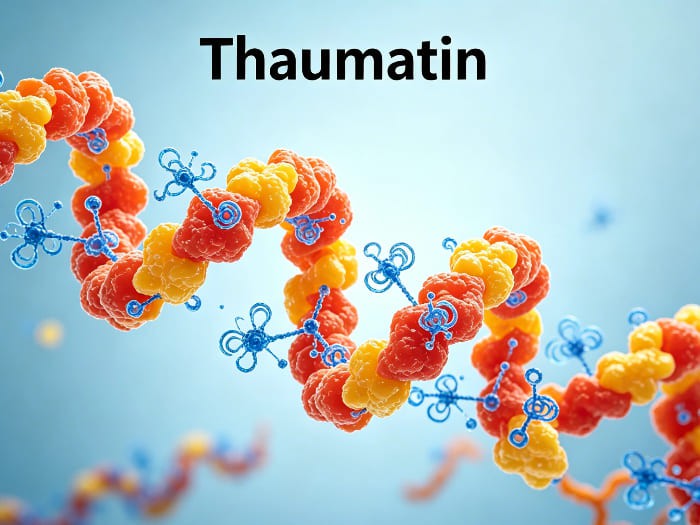
1. The Biochemical Foundation: Thaumatin Structure and Stability
At the molecular level, thaumatin is a single-chain polypeptide consisting of 207 amino acids. Unlike many other proteins that denature under thermal stress, thaumatin stability is exceptionally high, making it a rare example of a "sweet protein" that can be used in high-heat applications like baking and UHT (Ultra-High Temperature) processing.
The Power of Eight Disulfide Bonds
The remarkable resilience of the protein is attributed to eight internal disulfide bonds (covalent linkages between cysteine residues). These bonds act as molecular "staples" that lock the protein into a compact, globular fold.
- Heat Resistance: This rigid structure allows the protein to maintain its sweet-tasting conformation at temperatures exceeding 100°C, particularly in acidic environments (pH 2.5–5.0).
- pH Stability: It remains stable across a wide range, from acidic carbonated beverages to neutral dairy systems.
- Industrial Advantage: For formulators, this means thaumatin can be added before pasteurization or extrusion without losing its functional potency.
2. Molecular Mechanism of Sweetness Perception
The intensity of thaumatin's sweetness-and its distinctive temporal profile-is explained by its interaction with human taste receptors. Unlike small-molecule sweeteners (like sucrose or aspartame), the thaumatin structure interacts with receptors in a highly specific, high-affinity manner.
G-Protein Coupled Receptor (GPCR) Binding
Thaumatin targets the transmembrane T1R2/T1R3 heterodimer receptor, the primary sensor for sweetness in the oral cavity.
- High-Affinity Binding: The large surface area of the thaumatin protein allows for multiple contact points with the T1R2/T1R3 receptor. This results in a "strong" signal cascade, which explains why it is perceived as thousands of times sweeter than sugar.
- The Lag Time Phenomenon: Because of its large molecular size and the strength of its binding, the onset of sweetness is slightly delayed compared to sucrose. However, this same mechanism ensures that the sweetness is exceptionally long-lasting, making it an ideal tool for products requiring a prolonged sensory experience, such as chewing gum or long-shelf-life nutraceuticals.
3. Beyond Sweetness: Flavor Enhancement and Bitterness Masking
In many B2B applications, thaumatin is utilized at "sub-threshold" levels-concentrations so low that the protein itself provides no discernible sweetness, but its flavor-enhancer properties become the dominant function.
Competitive Inhibition and Masking
Formulators working with plant-based proteins, Stevia, or vitamins often face a "bitter tail" or metallic aftertaste. Thaumatin mitigates this through two primary pathways:
- Receptor Competition: The protein physically interacts with or masks specific bitter-taste receptors, effectively "blocking" the signal before it reaches the brain.
- Sensory Rounding: By smoothing the sharp "peaks" of intense sweeteners (like Rebaudioside A), thaumatin creates a more sucrose-like taste curve.
Improving Mouthfeel in Low-Fat Formulations
Thaumatin interacts with salivary proteins and the oral mucosa to increase the perception of "body" and creaminess. This is particularly valuable in low-fat or low-sugar dairy and beverage formulations where the removal of solids typically leads to a thin, watery mouthfeel.
4. Synergistic Effects: Creating the Perfect Sucrose Profile
One of the most valuable aspects of thaumatin stability and chemistry is its synergy with other natural sweeteners. In the B2B sector, "blending" is the standard for achieving the most cost-effective and palatable results.
Thaumatin vs. Stevia and Monk Fruit
When used in isolation, high-intensity natural sweeteners often have sensory flaws. Thaumatin acts as the "bridge" in these formulations:
- With Stevia: It masks the lingering bitterness and metallic notes of Rebaudioside M or D.
- With Sugar Alcohols (Erythritol/Xylitol): It extends the sweetness duration, compensating for the rapid "cooling effect" of polyols.
Synergy Table for Formulators:
| Sweetener Blend | Primary Benefit of Adding Thaumatin | Sensory Impact |
| Stevia (Reb A) | Masking bitter aftertaste | Sucrose-like finish |
| Monk Fruit | Rounding out flavor "voids" | Fuller mouthfeel |
| Allulose/Erythritol | Extending sweetness duration | Persistent sweetness |
| Plant Proteins | Masking "earthy" or "beany" notes | Improved palatability |
5. Summary: The B2B Strategic Value of Thaumatin
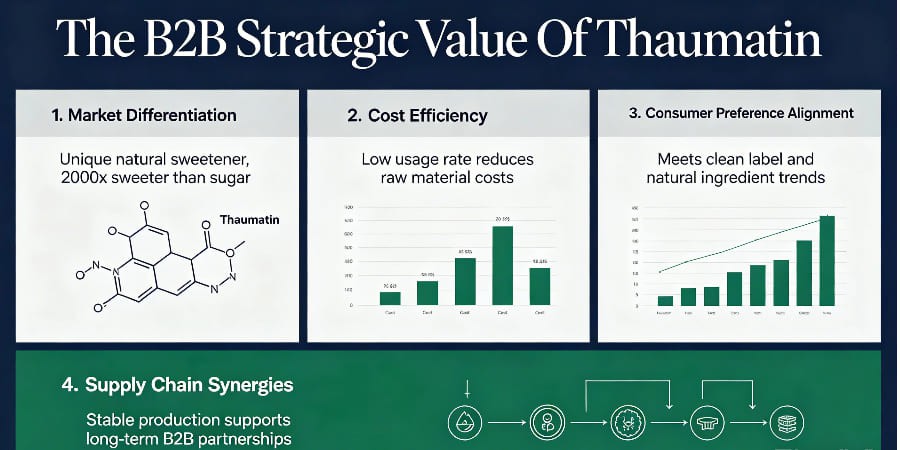
From a procurement and R&D perspective, thaumatin is a multifunctional tool that solves the three core challenges of modern food development: stability, taste, and label transparency. Its protein-based nature allows for a "Natural Flavoring" or "Natural Sweetener" designation, while its unique disulfide-crosslinked thaumatin structure ensures it survives rigorous industrial processing. By leveraging its synergistic properties, manufacturers can achieve significant sugar reduction and cost-of-use efficiency without compromising the sensory integrity that consumers demand. For the professional buyer, thaumatin is not merely a sweetener; it is a high-performance flavor stabilizer that future-proofs products against the "sugar tax" and the rising demand for clean-label solutions.
Partner with Technical Experts
Are you ready to optimize your next formulation? EmerWell provides pharmaceutical-grade, high-purity Thaumatin solutions backed by comprehensive stability data.
- [Request a Sample]: Test our heat-stable Thaumatin in your specific application.
- [Get Technical Data Pack]: Access COAs, stability studies, and MSDS.
- [Consult on Custom Specs]: Discuss specific concentrations or carrier requirements.
- [Book a Technical Meeting]: Schedule a deep-dive session with our lead chemists to solve your flavor challenges.
For technical support and formulation consultation, contact our engineering team: liu@wellgreenxa.com.
References
- EFSA Panel on Food Additives and Flavourings (FAF). (2021). "Re‑evaluation of thaumatin (E 957) as food additive." EFSA Journal, 19(11), e06884. DOI: 10.2903/j.efsa.2021.6884.
- Joseph, J. A., Akkermans, S., Van der Borght, M., & Van der Meeren, P. (2019). "Sweet proteins: A sweetener of the future with unique structure-function properties." Critical Reviews in Food Science and Nutrition, 59(11), 1731-1752. DOI: 10.1080/10408398.2017.1423122.
- Masuda, T., & Kitabatake, N. (2006). "Developments in biotechnological production of sweet proteins." Chemical Senses, 31(1), 39-45. DOI: 10.1093/chemse/bjj003.
- U.S. Food and Drug Administration (FDA). (2020). "GRAS Notice (GRN) No. 920: Thaumatin II (Agency Response Letter)." Center for Food Safety and Applied Nutrition (CFSAN).
- Yamada, K., et al. (2022). "Structure of thaumatin under acidic conditions: Structural insight into the conformations in lysine residues responsible for maintaining the sweetness after heat-treatment." Food Chemistry, 389, 132996. DOI: 10.1016/j.foodchem.2022.132996.
- Joint FAO/WHO Expert Committee on Food Additives (JECFA). (2024). "Safety evaluation of certain food additives: One-hundredth meeting of JECFA." WHO Food Additives Series, No. 91.
- O'Donnell, K., & Kearsley, M. W. (Eds.). (2012). Sweeteners and Sugar Alternatives in Food Technology (2nd ed.). Wiley-Blackwell. ISBN: 978-0470659687.
