




For procurement managers and formulation teams developing omega-3 products, the fishy taste and odor remain among the most persistent barriers to consumer acceptance. In sensitive categories such as infant nutrition, premium pet supplements, and functional beverages, even a trace of off-flavor can compromise product viability. Liposomal omega-3 powder addresses this formulation challenge at the molecular level-not by masking odors with flavors, but by significantly reducing the oxidative degradation that causes them under controlled storage conditions and optimized formulation systems.
Decision Line: Liposomal omega-3 is most suitable for applications where sensory neutrality is critical-infant formula, clear beverages, and premium unflavored powders. It is not recommended for bulk oil applications where simpler encapsulation is more cost-effective.
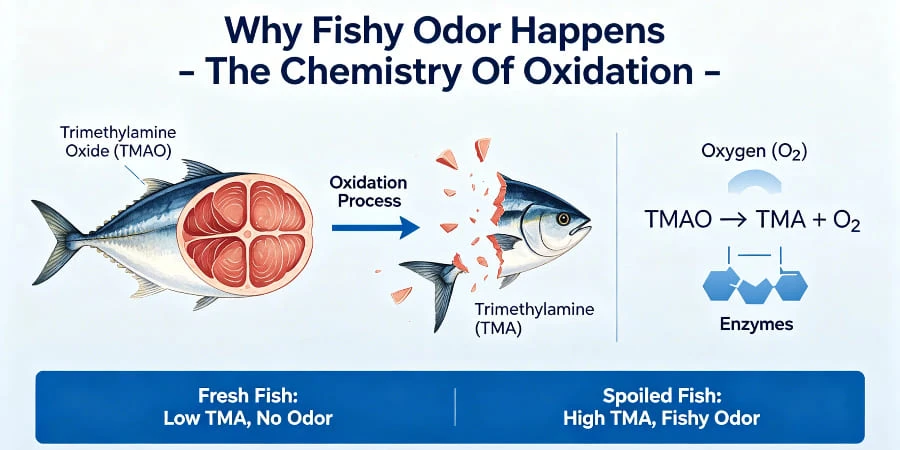
Why Fishy Odor Happens: The Chemistry of Oxidation
The fishy taste and odor associated with omega-3 ingredients are not inherent properties of EPA and DHA themselves-they are the result of oxidation. The omega-3 fatty acids DHA and EPA are highly unsaturated, and their high degree of unsaturation makes them more prone to oxidation. Oxidation occurs when atmospheric oxygen reacts with the unsaturated fatty acids and, through a series of chain reactions, breaks the DHA and EPA down into smaller molecules.
The oxidation pathway:
- Primary oxidation: Oxygen reacts with omega-3 fatty acids to form hydroperoxides.
- Secondary oxidation: Hydroperoxides decompose into volatile aldehydes, unsaturated ketones, and furan derivatives.
- Sensory impact: The volatile substances often contribute to the fishy off-flavor experienced in oxidized fish oil or omega-3 concentrates.
The autoxidation of EPA and DHA leads to a mixture of odorants eliciting an overall fishy odor quality. The fishiest odor is produced by EPA oxidized by copper ions. Eleven specific compounds have been identified as contributing to fishy off-odors in oxidized omega-3 oils.
Decision Line: The root cause of fishy taste is oxidation, not the omega-3 molecules themselves. Effective solutions must address oxidation prevention, not just flavor masking.
Why Traditional Solutions Fail: Gap Analysis
| Approach | Mechanism | Limitation |
|---|---|---|
| Flavor masking | Adding natural or artificial flavors to cover fishy notes | Does not address underlying oxidation; off-flavors intensify over time |
| Standard microencapsulation | Spray-dried starch or gelatin coatings | Not impermeable to oxygen; odors develop or leak over shelf life |
| Deodorization | Physical or chemical removal of volatile compounds | Does not prevent re-oxidation during storage |
Microencapsulated omega-3 PUFAs have shown a significant (p = 0.02) fishy flavor in sensory evaluations. By the time the fishy taste is noticeable in a finished product, significant nutritional degradation has already occurred.
Decision Line: Traditional approaches treat symptoms, not causes. For long-term stability, a more fundamental solution is required.
Liposomal Mechanism: How It Works
Liposomal omega-3 powder offers a fundamentally different approach: instead of masking odors, liposomal encapsulation significantly reduces the oxidative degradation that creates them.
How liposomal delivery works. Liposomes are microscopic phospholipid vesicles that encapsulate omega-3 fatty acids within a bilayer that structurally mimics cell membranes:
- Diffusion-limiting barrier: The phospholipid bilayer provides a reduced oxygen diffusion rate compared to conventional coating systems. Liposomes act as a diffusion-limiting system rather than an absolute oxygen barrier.
- Protection of the active ingredient: Nanoliposomal encapsulation protects omega-3 PUFAs during storage, maintaining higher DHA and EPA content.
- Reduced fishy flavor: Lipid vesicular systems can encapsulate and protect omega-3 for the production of functional foods with appropriate organoleptic properties.
Published research supports:
- A 2020 study in the Nanomedicine Journal found that all amphiphiles tested formed omega-3 vesicles with masked omega-3 taste and smell. Span/Tween (ST) 60 niosomes achieved the highest encapsulation efficiency (98.60%).
- A 2017 study in Food Chemistry reported no significant (p = 0.11) detectable difference between control and nanoliposomal omega-3 enriched samples, while samples enriched with unencapsulated or microencapsulated omega-3 showed significant (p = 0.02) fishy flavor.
- Significantly (p < 0.01) higher omega-3 recovery and lower peroxide and anisidine values were observed in nanoliposomal omega-3 enriched samples.
The sensory result: Because omega-3 molecules are protected within the liposomal core, the fatty acids have substantially reduced direct interaction with the consumer's taste buds. The result is significantly reduced fishy notes under controlled storage conditions and optimized formulation systems.
Decision Line: Liposomal encapsulation significantly reduces oxidation rate and delays fishy note formation-but it is a reduction, not an elimination. Effectiveness depends on phospholipid quality, antioxidant systems, and storage conditions.
Key Risk Factors: What Can Go Wrong
Liposomal omega-3 systems can fail through several mechanisms. Understanding these failure modes is essential for evaluating supplier capability.
| Failure Mode | Cause | Mitigation |
|---|---|---|
| Phospholipid oxidation | PUFA-rich bilayer lacking antioxidant protection; phospholipids themselves can oxidize and generate off-flavors | Use saturated phospholipids or add tocopherols; monitor phospholipid quality |
| Vesicle rupture | Humidity cycling during storage; water activity increases accelerate hydrolysis and oxidation | Maintain low water activity (<0.3); use moisture-barrier packaging |
| Spray-drying thermal stress | Thermal stress during drying can affect liposome integrity | Optimize drying conditions; consider freeze-drying alternatives |
| Oil leakage over time | Gradual vesicle disruption leads to a transition from encapsulated to free oil phase | Monitor leakage kinetics; use stable phospholipid compositions |
| Oxygen permeability | Lipid bilayer reduces oxygen diffusion but does not completely block it | Use oxygen-barrier packaging; consider nitrogen flushing |
The system-level reality: Omega-3 stability is not controlled by any single factor-it is governed by a multi-variable system. Key variables include:
- Core oil oxidation (primary driver)
- Phospholipid oxidation (secondary off-flavor source)
- Water activity (aw ↑ → hydrolysis + oxidation acceleration)
- Oxygen permeability of packaging
- Process shear history
- Storage temperature cycling
Decision Line: Liposomal encapsulation is one layer within a multi-barrier stability system, not a standalone solution. Effective sensory protection requires assessment of multiple interacting factors.
Performance Comparison: Liposomal vs. Alternatives
| Feature | Standard Fish Oil | Microencapsulated Powder | Liposomal Omega-3 Powder | Industrial Reality |
|---|---|---|---|---|
| Oxidation protection | Low | Moderate | Significantly improved under controlled conditions | Not absolute; phospholipid oxidation possible |
| Peroxide value (POV) | Often exceeds 5 meq/kg | 3–5 meq/kg | Often targeted at ≤2.0 meq/kg in premium-grade systems | GOED limit: PV < 5 mEq/kg oil |
| Anisidine value (p-AV) | Often elevated | Variable | Below industry thresholds | GOED limit: p-AV < 20 |
| Sensory profile | Pronounced fishy taste | Variable; can develop off-notes | Substantially reduced fishy notes under controlled conditions | May develop over extended storage |
| Flavor masking required | Extensive | Moderate | Minimal | Depends on application sensitivity |
| Shelf life stability | Short | Moderate | Extended | Dependent on phospholipid quality and storage |
| Water activity sensitivity | Low (liquid) | Moderate | Significant | aw management critical for powder stability |
| Consumer compliance | Low | Moderate | High | Delayed release reduces immediate perception |
Decision Line: For applications where sensory neutrality is critical, liposomal omega-3 offers a significant commercial advantage. For cost-sensitive bulk applications, microencapsulation may be more appropriate.
Procurement Checklist: What to Verify
For B2B buyers evaluating liposomal omega-3 powder, the following criteria provide a framework for informed sourcing decisions:
1. Oxidation control (POV and p-AV). GOED monograph limits oxidation at PV < 5 mEq/kg oil and p-AV < 20. Premium-grade liposomal systems often target PV ≤ 2.0 meq/kg, but this is an internal specification rather than an industry standard. Request both values.
2. Phospholipid quality and antioxidant system. The oxidative stability of the liposomal carrier itself is critical. Request information on phospholipid composition (saturated vs unsaturated), antioxidant system (e.g., alpha-tocopherol), and source.
3. Encapsulation efficiency and leakage kinetics. Request leakage rate data (% per 30, 60, 90 days) to understand long-term stability.
4. Particle size and stability. Optimal liposomal omega-3 formulations typically report particle sizes in the 150–200 nm range with good colloidal stability.
5. Water activity and moisture management. Request water activity (aw) data alongside traditional oxidation metrics. Low aw (<0.3) is essential for long-term powder stability.
6. Analytical documentation. Batch-specific Certificates of Analysis (COA) including total omega-3 content (EPA + DHA), POV, p-AV, heavy metal analysis, water activity, and microbiological safety data.
7. Certifications and compliance. cGMP, ISO 22000, FSSC 22000, HACCP, Kosher, Halal, Non-GMO Project Verified.
Decision Line: The most cost-effective omega-3 ingredient is not necessarily the cheapest per kilogram-it is the one that delivers stable sensory performance while minimizing formulation risk and consumer complaint costs.
Application Suitability Map
| Application | Suitability | Rationale |
|---|---|---|
| Infant formula | HIGH | Sensory critical; zero tolerance for off-flavors |
| Functional beverages (clear systems) | HIGH | Sensory critical; liposomal dispersibility in aqueous systems |
| Premium pet supplements | MEDIUM-HIGH | Odor masking important; cost-sensitive but premium segment supports investment |
| Capsules (enteric-coated) | MEDIUM | Less sensory exposure; cost-sensitive |
| Capsules (standard) | LOW-MEDIUM | Minimal taste exposure; simpler encapsulation may be more cost-effective |
| Bulk oil | NOT SUITABLE | Over-engineering, microencapsulation, or liquid format is more appropriate |
Decision Line: Liposomal omega-3 delivers maximum value in applications where sensory neutrality is a competitive differentiator. In applications where taste exposure is minimal, simpler solutions may be more cost-effective.
Conclusion
For B2B procurement managers and product developers, the fishy taste problem in omega-3 formulations is not an unavoidable compromise-it is a technical challenge with a proven solution. Conventional approaches treat symptoms without adequately managing the root cause. Liposomal omega-3 powder takes a fundamentally different approach: by creating a phospholipid barrier that significantly reduces oxygen diffusion, it substantially delays the formation of volatile oxidation products that create fishy odors.
However, liposomal encapsulation is one layer within a multi-barrier stability system, not a standalone solution. Effective sensory protection depends on phospholipid quality, antioxidant systems, water activity control, packaging integrity, and storage conditions. By partnering with a technically transparent supplier that provides validated stability data, leakage kinetics, water activity data, and batch-specific analytical certification, manufacturers can deliver omega-3 products that are stable, sensory-neutral, and commercially viable across even the most sensitive applications.
- [Download specification sheet] – Review full technical parameters and compliance documentation.
- [Request stability data] – Access PV / p-AV / water activity / leakage kinetics reports.
- [Request sample/quotation] – Test our liposomal omega-3 powder grades (≥25% total omega-3) in your own formulation matrix.
MOQ, lead time, and bulk pricing available upon request. For technical support and bulk quotations, contact our engineering team at liu@wellgreenxa.com.
References
- Shariat, S., Hakimzadeh, V., & Pardakhty, A. (2020). The physicochemical and organoleptic evaluation of the nano/micro encapsulation of Omega-3 fatty acids in lipid vesicular systems. Nanomedicine Journal, 7(3).
- Rasti, B., Erfanian, A., & Selamat, J. (2017). Novel nanoliposomal encapsulated omega-3 fatty acids and their applications in food. Food Chemistry, 230, 690-696.
- GOED Voluntary Monograph – Oxidation limits (PV < 5 mEq/kg oil, p-AV < 20).
- Model Studies on the Key Aroma Compounds Formed by an Oxidative Degradation of ω-3 Fatty Acids. (2013). Journal of Agricultural and Food Chemistry.
- VivoMega (2022). Omega-3s and oxidation: The value of low oxidation in omega-3 oils. Nutritional Outlook
