



Organic Matcha Tea Powder is a premium ingredient in food, beverage, nutraceutical, and cosmetics supply chains. As global demand grows, so does regulatory scrutiny: import rules, organic certification recognition, pesticide and heavy-metal limits, labeling, and sanitary requirements vary across markets. This guide walks procurement, quality, and regulatory teams through the critical compliance checkpoints for major markets (U.S., EU, Japan, Korea, Southeast Asia), explains the documentation you must obtain and maintain, and gives a practical checklist to lower regulatory risk and speed market entry.
NOTE: This article focuses on regulatory requirements and practical steps for B2B sourcing and export readiness; it does not provide legal advice. Always validate final requirements with local authorities, accredited certifiers, and your customs broker.

1. Why compliance matters for organic matcha buyers
Organic matcha is marketed not only for its sensory and functional properties, but also for its organic provenance and "clean-label" positioning. Any gap in regulatory compliance - missing organic import certificates, unacceptable pesticide residues, incorrect labeling, or lack of batch traceability - can cause shipments to be detained, rejected, or destroyed, damage customer relationships, and expose buyers to financial loss and reputational harm. U.S. and other markets now require stricter documentary proof for organic imports, increasing the importance of documented supply-chain controls.
2. United States - key rules and importer responsibilities
What to know
Regulatory authorities: U.S. Food and Drug Administration (FDA) oversees the safety, labeling and sanitary aspects of food imports; the USDA National Organic Program (NOP) governs organic certification and import documentation. Imported foods must meet the same safety and labeling laws as domestic goods.
Organic import certificate (NOP Import Certificate / NOPIC): As part of strengthened enforcement, imported organic agricultural products must be accompanied by a valid NOP Import Certificate issued by the exporting certifier (or otherwise meet the equivalence arrangements). From October 1, 2025, shipments arriving without a valid NOPIC risk reexport, destruction or other enforcement action. Confirm your supplier provides batch-specific NOPICs before shipment.
Practical steps for buyers
- Require batch-specific CoA + NOP Import Certificate before shipment.
- Ensure the importer of record is a USDA-certified importer when required.
- Work with your customs broker to confirm ACE filing codes and documentation to avoid holdups at the port.
3. European Union - food safety, MRLs, and organic recognition
What to know
Food safety & labeling: The EU enforces food safety (General Food Law) and specific rules on contaminants, additives and labeling. Matcha imported as an organic product must meet EU organic rules unless covered by an accepted equivalence arrangement.
Pesticide MRLs and monitoring: Tea and powdered botanicals are subject to MRL checks. Some regulatory shifts and consultations in pesticide policy are underway in Europe; buyers must stay current on which active substances and MRLs apply for tea leaves and powdered teas in target member states. Recent proposals and regulatory reviews may change permitted substances or review periods - monitor EU updates and EFSA communications.
Practical steps for buyers
Obtain supplier CoAs for pesticide residues and heavy metals referenced to EU-recognized methods.
Confirm whether the supplier's organic certification is accepted for EU entry (or whether additional documentation is required).
Ask for details of post-harvest handling (drying, storage) and any processing aids used; these affect classification and MRL expectations.
4. Japan - JAS organic and import documentation
What to know
Organic JAS: Japan's Organic JAS has strict rules for organic labeling and import. Imports can be distributed with the Organic JAS mark if accompanied by appropriate certificates or if the overseas producer is JAS-certified under approved arrangements. Japan's trade handbooks and customs require precise documentation for organic marking and import clearance.
Practical steps for buyers
Confirm whether the exporting operation is recognized under Japan's organic arrangements or whether a certified Japanese importer will re-certify/verify.
Provide clean, translated technical documentation and CoAs to speed customs review.
5. South Korea, Southeast Asia & other APAC markets - local tests and labeling
What to know
Many Asian markets require pesticide screening, heavy-metal limits and food-safety declarations. Specific allowed pesticide lists and MRLs can differ from EU/US lists. Korea, for example, has its own residue limits and labeling laws; ASEAN members may have varying requirements depending on product use (food vs ingredient vs supplement).
Practical steps for buyers
Before committing to supply, obtain region-specific CoA panels (pesticides, heavy metals, microbes) relevant to your target market.
Clarify whether your matcha will be sold as a food, supplement or cosmetic ingredient - classification affects which tests and labels apply.
Work with a local importer or regulatory consultant to ensure packaging/labeling meets language and claims rules.
6. Core laboratory and documentation requirements every buyer should insist on
For any export/import lane, require the supplier to provide the following batch-specific documents:
- Certificate of Analysis (CoA) - includes pesticide residues (full panel), heavy metals (Pb, Cd, As, Hg), moisture, ash, microbial test results, and active markers if relevant (chlorophyll, catechins/L-theanine).
- Organic certification & NOP/NOPIC or equivalent documentation - for shipments to the U.S. and other markets requiring importer/shipper certification.
- GMP / HACCP / ISO documentation - production and food-safety management evidence.
- Traceability records - raw-material origin, harvest date, processing batch number and packaging details.
- MSDS / technical datasheet - product handling, storage conditions and recommended shelf life.
- Shipping & customs paperwork - HS code, commercial invoice, packing list, origin certificate, and any phytosanitary or special permits required for the target market.
These items reduce customs friction and support rapid market release.
7. Quality control beyond the lab: audits, sampling and stability
Laboratory testing is necessary but not sufficient. Buyers should verify supplier capabilities through:
- Factory audits (virtual or on-site): review hygiene, storage, processing flow, and sample retention procedures.
- Incoming raw-material controls: evidence of farm audits or supplier QA for harvested leaves (shade duration, pesticide application records).
- Retention sample policy: suppliers should hold retention samples for each production lot for at least the expected shelf-life plus a margin for dispute resolution.
- Accelerated and real-time stability data: to support shelf-life claims and packaging decisions, especially when supplying premixed powders or RTD beverage applications.
8. Claims, labeling and marketing: stay conservative and compliant
Botanical ingredients attract stringent claim scrutiny. For organic matcha:
- Avoid medical or disease-treatment claims. Use structure-function or nutrient statements supported by compositional facts (e.g., "contains naturally occurring catechins").
- Ensure labeling language, country of origin statements, and the use of organic seals comply with each destination's rules. For example, using a national organic logo on packaging requires specific certification recognition.
- Keep marketing materials aligned with the CoA and technical datasheet to avoid mismatched product claims during audits.
9. Risk scenarios and mitigation strategies
Common issues: missing NOPIC, unexpected pesticide detection above MRL, high heavy-metal levels (lead), incorrect labeling, or poor moisture control leading to microbial growth.
Mitigations:
- Pre-shipment testing: an independent lab test on the final packed product before shipment.
- Dual-certification approach: where possible, obtain certifications recognized by target markets (e.g., USDA + EU or JAS) to broaden market access.
- Insurance and contingency planning: include clauses for rejected shipments, and maintain diversified inventory or alternate suppliers for continuity.
10. Practical compliance checklist for procurement teams
Use this quick checklist when qualifying suppliers and approving shipments:
☐ Batch-specific CoA (pesticide panel, heavy metals, microbes, moisture)
☐ Organic certificate + NOPIC (for U.S.) or market-equivalent organic proof (EU, JAS)
☐ GMP / HACCP certs and on-site QA lab evidence
☐ Factory traceability records (farm → processing → lot)
☐ Retention sample policy & stability data
☐ Clear labeling data and claim compliance confirmation for target market
☐ Pre-shipment third-party test (recommended for new suppliers or lanes)
11. How a trusted supplier (e.g., Wellgreen) supports compliance
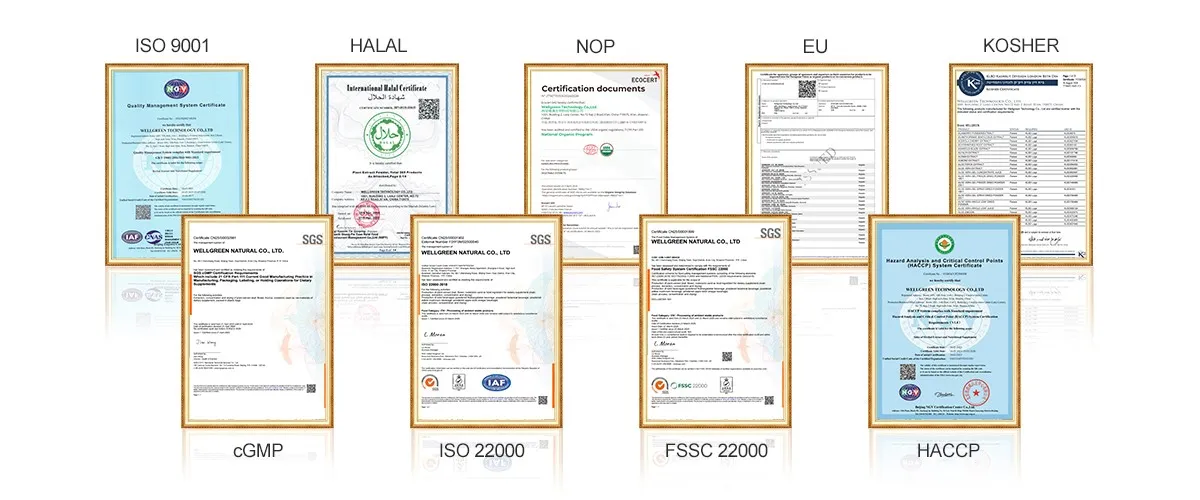
A professional supplier that is serious about global supply will offer: documented traceability, batch-specific CoAs, NOP/NOPIC support, robust onsite QC (HACCP/GMP), support for buyer audits, stability data and tailored documentation for each market. When your supplier proactively provides the right paperwork and technical support, your time to market shortens and compliance risk falls dramatically. (This is the advantage you should highlight when pitching your sourcing credentials.)
12. Final notes - stay updated and partner locally
Regulations evolve. For example, pesticide authorizations and MRL policies in the EU have been subject to review and change, and the U.S. has tightened organic import documentation rules in recent enforcement initiatives. Always confirm current rules with regulatory sources, your certifier, and customs broker before shipment.
Conclusion & Call to Action
Organic Matcha Tea Powder can open high-value markets - but only when compliance is treated as a core part of procurement and supply-chain strategy. Requiring batch-specific CoAs, valid organic import documentation (e.g., NOPIC for U.S. shipments), robust traceability and supplier audit evidence will reduce detention risk and protect your brand.
If you're sourcing organic matcha for food, beverage, or nutraceutical applications and need a partner who provides full traceability, market-aligned CoAs, export documentation support, and audit-ready quality systems, we can help. Contact us to request sample CoAs, NOP/NOPIC handling guidance, stability data, and a supplier audit pack - we'll support your regulatory review and get your ingredient cleared for the target market.
👉 Request documentation or a sample batch today - share your target market(s) and required test panels, and we'll prepare a compliance package tailored to your needs.
