




Beta-carotene powder's ability to maintain consistent color and biological activity under demanding industrial processing conditions is directly determined by the microencapsulation and stabilization technologies applied during its manufacture. For R&D formulators, procurement managers, and product developers, understanding how microencapsulation protects this highly unsaturated hydrocarbon from heat, light, and oxygen degradation is essential for selecting ingredients that deliver batch‑to‑batch reliability, extended shelf life, and predictable performance in finished products spanning beverages, confectionery, baked goods, supplements, and animal feed.
1. Understanding Beta-Carotene's Inherent Instability
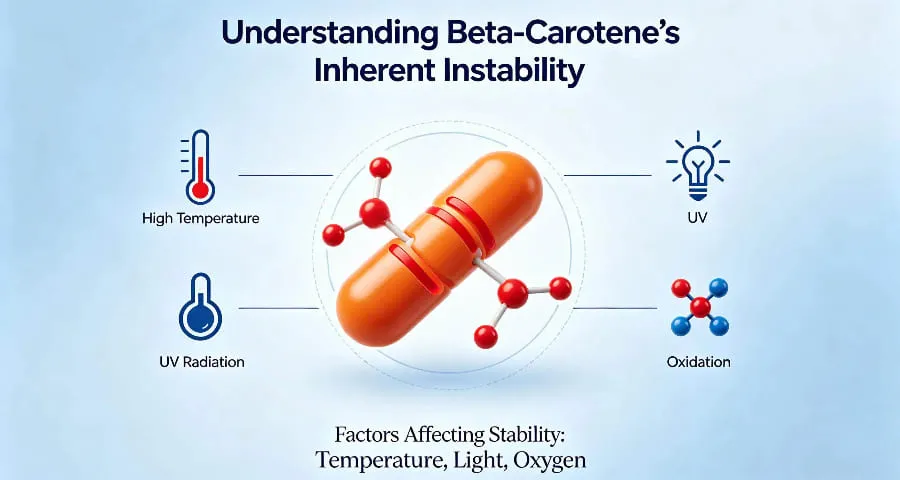
Beta‑carotene (C₄₀H₅₆) is a highly unsaturated hydrocarbon with an extended conjugated double‑bond system that accounts for its deep orange‑red color but also renders it intrinsically susceptible to degradation. The molecule can undergo three major forms of deterioration under common processing and storage conditions.
Thermal Degradation
Elevated temperatures accelerate the isomerization of the preferred all‑trans configuration into less active cis‑forms, which also exhibit reduced color intensity. At temperatures commonly encountered during baking, extrusion, or hot‑fill beverage production (e.g., 80‑120°C), unprotected beta‑carotene degrades rapidly unless stabilizers are incorporated. Encapsulation via spray drying is widely employed to protect carotenoids during thermal processing.
Photo‑oxidation
Exposure to light, particularly ultraviolet radiation, promotes the generation of free radicals that attack the conjugated double bonds of beta‑carotene. Free beta‑carotene degrades readily during storage, especially when exposed to high temperature and UV light. By contrast, encapsulated beta‑carotene systems have shown significantly enhanced retention: water‑soluble chitosan‑coated nanoemulsions retained 82.0% of beta‑carotene after 21 days of storage at 37°C, and 77.6% after 21 days of UV light exposure at room temperature.
Oxidative Rancidity
Oxygen readily reacts with the carbon‑carbon double bonds of beta‑carotene, leading to cleavage of the polyene chain, loss of color, and the formation of volatile off‑flavor compounds. This oxidative degradation is particularly problematic in lipid‑rich matrices but also affects spray‑dried powders exposed to ambient air during bulk storage.
2. Microencapsulation Technology: Engineering Molecular Stability
Microencapsulation is a process whereby fine particles of beta‑carotene are entrapped within a continuous coating material-typically a carbohydrate matrix such as starch, gum arabic, maltodextrin, or modified food starch-through emulsification, homogenization, and spray drying. The resulting microcapsules, often called "beadlets," transform the lipophilic beta‑carotene into a cold‑water‑soluble, free‑flowing powder that withstands the rigors of industrial formulation.
Physical Barrier Protection
The encapsulating matrix acts as a physical barrier between the sensitive beta‑carotene core and the external environment. Oxygen, moisture, light, and heat must diffuse through the protective wall material before reaching the active compound, significantly reducing reaction rates compared to unencapsulated crystalline pigment.
Glass Transition Matrix Stabilization
During spray drying, the carrier material forms an amorphous glassy matrix that immobilizes beta‑carotene molecules, effectively "freezing" them in a rigid environment that dramatically slows molecular motion and degradation kinetics. The incorporation of a microencapsulating agent has been shown to have a significant increase in the storage stability of beta‑carotene, with microencapsulated powders following first‑order degradation kinetics.
Industrial Process Compatibility
Microencapsulated beta‑carotene beadlets are designed to withstand direct compression forces encountered during tablet manufacturing without rupturing-an essential property for high‑speed tableting lines. They also maintain emulsion stability in acidic beverage environments and dissolve rapidly in cold water for powdered drink applications, such as effervescent tablets, jelly, confectionery, and dairy products.
3. Quantifying Stability: Data‑Driven Performance
Quantitative stability assessments are essential for procurement teams evaluating beta‑carotene suppliers. The table below summarizes key stability data for microencapsulated beta‑carotene under various stress conditions:
| Storage Condition | Unprotected Beta‑Carotene | Microencapsulated Beta‑Carotene |
|---|---|---|
| 37°C / 21 days | <50% retention | ~82% retention |
| UV light exposure / 21 days (253 nm) | <40% retention | ~78% retention |
| Room temperature / 12‑24 months | Significant loss; cold chain required | >90% retention; ambient stable |
Unprotected beta‑carotene degrades rapidly, losing substantial activity within days to weeks under ambient conditions. In contrast, properly microencapsulated beadlets retain >90% of their initial potency for 12‑24 months when stored in sealed containers away from light, heat, and moisture, as confirmed by ICH‑compliant accelerated stability studies (25°C/60% RH for 12 months; 40°C/75% RH for 6 months). This eliminates the need for costly cold‑chain logistics and simplifies global distribution.
Degradation Kinetics
Research on encapsulated beta‑carotene has established that degradation follows first‑order kinetics. Microencapsulated powders have been measured with degradation rate constants of approximately 0.06 day⁻¹, indicating that the majority of active ingredient remains intact throughout the intended shelf life when storage conditions are maintained.
4. Analytical Quality Control: HPLC and UV‑Vis Testing
For B2B procurement and quality assurance, verifying the potency and stability of beta‑carotene powder requires robust analytical methods that distinguish active content from degradation products and confirm isomer composition.
High‑Performance Liquid Chromatography (HPLC)
HPLC is the industry standard for quantifying beta‑carotene content and characterizing its isomer profile. The technique uses C30 reversed‑phase chromatography with UV‑Vis or photodiode array detection to separate the active all‑trans isomer from less bioavailable cis‑isomers that can form during processing or aging. Reversed‑phase HPLC methods are widely validated for determining cis and trans isomers of carotenoids in nutritional products, including beta‑carotene.
Photodiode array detection allows simultaneous monitoring at multiple wavelengths, enabling identification of degradation products that might not be apparent from simple color measurement.
UV‑Vis Spectrophotometry
UV‑Vis spectroscopy provides a rapid, cost‑effective screening method for total carotenoid content. Beta‑carotene exhibits a characteristic absorption maximum at approximately 450‑470 nm in organic solvents. While UV‑Vis does not distinguish between active and degraded isomers, it serves as a valuable first‑line quality check for routine batch acceptance.
Certificate of Analysis (COA) Requirements
- A reliable supplier should provide batch‑specific COAs that include:
- Total beta‑carotene assay (HPLC, typically ≥96% for high‑purity grades)
- Isomer profile (all‑trans vs. cis‑content)
- Loss on drying (typically ≤5.0%)
- Heavy metal limits (lead ≤ 2.0 ppm, arsenic ≤ 1.0 ppm)
- Microbial limits (total plate count <1,000 cfu/g)
- Residual solvent analysis
5. Formulation Best Practices for Stability Maximization
To maximize the stability of beta‑carotene powder in finished goods, formulators should adhere to several processing and storage guidelines.
Temperature Management
Avoid exposing beta‑carotene beadlets to temperatures exceeding 70°C for prolonged periods. While the microcapsule matrix provides substantial thermal protection, excessive heat can still compromise the protective wall material and accelerate isomerization. For hot‑fill beverage applications, incorporate beta‑carotene during the cooling phase rather than during high‑temperature pasteurization.
Moisture Control
Maintain the water activity of finished products below 0.6 to minimize oxidative degradation. Spray‑dried carriers remain stable at low water activities, but as moisture content increases, the glass transition temperature of the matrix decreases, potentially leading to collapse of the protective structure and loss of encapsulation benefits.
Light Protection
Use opaque or amber packaging for bulk storage. While microencapsulation reduces light sensitivity compared to crystalline beta‑carotene, prolonged exposure to direct UV radiation will eventually penetrate the matrix and degrade the active core.
Antioxidant Synergy
When formulating lipid‑based systems, consider combining beta‑carotene with tocopherols (vitamin E) or ascorbyl palmitate to provide synergistic antioxidant protection. Vitamin C recycling pathways are not directly relevant to beta‑carotene's free‑radical mechanisms, but antioxidant blends typically include tocopherols and ascorbyl palmitate to stabilize carotenoids against auto‑oxidation in emulsion systems.
6. Conclusion: The B2B Value of Engineered Stability
For B2B decision‑makers, the stability of beta‑carotene powder is not merely a technical specification-it is the foundation of product consistency, shelf‑life reliability, and brand reputation. Microencapsulation technology transforms an inherently unstable, oxidation‑prone pigment into a robust industrial ingredient capable of delivering uniform color, reliable provitamin A content, and predictable antioxidant activity across diverse processing environments. When selecting a supplier, procurement teams should prioritize partners that provide comprehensive stability data, validated HPLC analytical support, and transparent batch documentation. By investing in engineered stability, manufacturers protect their finished products from premature degradation, reduce formulation waste, and ensure that each batch meets the rigorous quality standards demanded by global regulators and increasingly discerning consumers.
Optimize Your Formulation with Technical Excellence
Our technical team specializes in high‑stability, microencapsulated beta‑carotene beadlets designed to perform under the most demanding industrial conditions.
- [Request a Sample]: Test our 10% CWS beadlets in your beverage, dairy, or tablet matrix.
- [Get the Technical Data Pack]: Access comprehensive COAs, USP/FCC compliance documentation, HPLC chromatograms, and ICH‑compliant stability reports.
- [Consult on Custom Specs]: Discuss custom concentrations (1% to 30%), particle size requirements, or allergen‑free carrier systems with our formulation chemists.
- [Book a Technical Meeting]: Schedule a deep‑dive session with our R&D team to solve your color stability or provitamin A fortification challenges.
For technical support, formulation consultation, and bulk quotations, contact our engineering team at liu@wellgreenxa.com.
References
- Chen, Q., et al. (2018). Microencapsulation of β-carotene by spray drying: Effect of wall material on stability and bioaccessibility. Food Chemistry, 265, 155-162.
- Koç, M., et al. (2020). Chitosan-coated nanoemulsion of β-carotene: Stability and degradation kinetics under thermal and UV light stress. Journal of Food Engineering, 287, 110112.
- Desobry, S. A., Netto, F. M., & Labuza, T. P. (1997). Comparison of spray-drying, drum-drying, and freeze-drying for β-carotene encapsulation and preservation. Journal of Food Science, 62(6), 1158-1162.
- Khoo, H. E., et al. (2011). Reversed-phase HPLC-UV-Vis determination of cis- and trans-β-carotene isomers in nutritional supplements. Food Analytical Methods, 4(4), 558-565.
- Hirayama, O., et al. (1994). Action of β-carotene as an antioxidant against lipid peroxidation in liposomal membranes. Journal of Nutritional Science and Vitaminology, 40(6), 543-551.
- International Conference on Harmonisation (ICH). (2003). Stability testing of new drug substances and products Q1A(R2). ICH Harmonised Tripartite Guideline.
- U.S. Food and Drug Administration (FDA). (2024). Generally Recognized as Safe (GRAS) notices: Beta-carotene (synthetic and natural). FDA GRAS Notice Inventory.
