



In the livestock production system, the abuse of antibiotics not only causes the generation of superbugs, but also causes the safety of livestock products and environmental pollution. In addition, some antibiotics have a broad spectrum of antibacterial activity against intestinal microorganisms, killing not only harmful bacteria but also beneficial bacteria. Therefore, long-term use of antibiotics will reduce the diversity of animal microbial communities and increase the chances of pathogen colonization in the intestinal tract. China's Ministry of Agriculture and Rural Affairs has stipulated that from July 1, 2020, feed manufacturers will stop producing commercial feeds containing growth-promoting pharmaceutical feed additives (except traditional Chinese medicine). In this context, it is particularly urgent to find green feed additives that can replace antibiotics. Plant essential oils are considered as potential substitutes for antibiotics due to their significant antibacterial activities. Citrus essential oils (CEOs) are among the largest and most commercially produced, because their costs are relatively low and contribute to wide production. CEOs are reported to have selective antibacterial activity and have little influence on the growth dynamics of beneficial bacteria, such as Lactobacillus, and large influence on harmful bacteria, such as Escherichia coli. The application of this property in animal production will be of great value. This paper focuses on the CEOs' antibacterial activities and their mechanisms of action to provide a theoretical basis for their application in animal production.

A. Brief introduction to CEOs
CEOs are aromas extracted from citrus plants, which are naturally green, non-toxic, non-residual and non-irritating, and mainly include sweet orange essential oil, grapefruit essential oil, lemon oil, bergamot essential oil, orange essential oil and bitter orange leaf essential oil. CEOs come from different parts of plants, like leaves, flowers, fruits, and skins. The common methods to extract and process CEOs are distillation, solvent method, squeezing method, supercritical nitrogen dioxide extraction method and molecular distillation, among which distillation is the most common and cleanest method, and 95% of plant essential oils can be extracted by distillation. CEOs have a wide range of biological activities, including antibacterial, antioxidant, and anti-inflammatory; It has a good application prospect on livestock and poultry because it can hinder the growth of mold in livestock and poultry shed, restrain or kill Salmonella and other harmful bacteria, improve environmental cleanliness and comfort of livestock and poultry. With the deepening of the research on substitution and the requirement of green, pollution-free, non-residual natural antibacterial agents, more and more studies are conducted on the CEOs' antibacterial biological activities, especially the research on their selective antibacterial activities has attracted our research group's attention, and more in-depth studies are planned to be carried out.
B. Chemical composition of CEOs
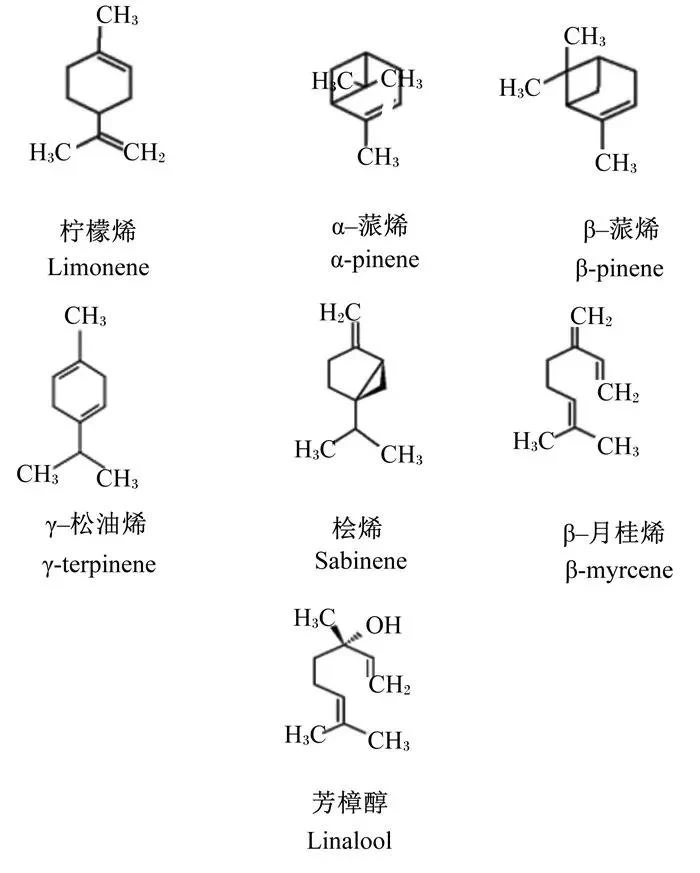
CEOs are complex hydrocarbons and mixtures of oxygen-containing derivatives of terpenes and non-terpenes, consisting of functional groups, including aldehydes, alcohols, ketones, and other complex molecules, such as esters and organic acids. CEOs vary in composition by variety, season, and location, and by fruit ripening stage, and contain a variety of compounds, Such as limonene, α-pinene, β-pinene, γ-terpinene, sabinene, β -Myrcene and Linalool (Figure 1). Typically, each CEOs contains 20 to 60 compounds, of which 85 to 99 percent are volatile compounds, mainly including monoterpene, sesquiterpenes, and sesquiterpenoids. Monoterpenes are the most important volatile compounds, mainly composed of two isoprene (C5H8). D-limonene is a monoterpene and is the main active ingredient of CEOs, the amount of which varies according to the type of CEOs. For example, bergamot essential oil contains 32% to 45% D-limonene, lemon oil 45% to 76%, and sweet orange oil 68% to 98% D-limonene. By understanding the chemical composition of CEOs, it is helpful to further study the effective active ingredients of CEOs that exert biological activity.
C. the antibacterial activity of CEOs
In recent years, plant essential oils have been widely paid attention to their antibacterial properties due to their broad spectrum antibacterial activity and low residual toxicity. CEOs and most of their compounds have antibacterial activities, for example, D-limonene has antibacterial, anti-inflammatory, antioxidant, and anticancer effects, and α -pinene and β -pinene have antibacterial, anti-inflammatory, and antioxidant effects, and more and more studies have been done on the antibacterial activities of CEOs in recent years. Therefore, this article focuses on the antimicrobial activity of several major CEOs.
3.1 Antimicrobial activity of several main CEOs
3.1.1 Sweet orange essential oil
Sweet orange essential oil is one of the few essential oils that has a calming effect. Sweet orange essential oil inhibits the growth of a variety of bacteria, These include Staphylococcus aureus, Listeria Monocytogenes, Vibrio Parahaemolyticus, Salmonella typhimurium and others Typhimurium); And several fungi, such as Aspergillus flavus, Aspergillus fumigatus, Aspergillus terreus and so on.
3.1.2 lemon oil
Lemon oil is a light yellow liquid with citrus aromas, refreshing and fresh. Lemon oil has effective antibacterial activity against Bacillus cereus, Klebsiella pneumoniae, Enterococcus faecalis, etc. It has antifungal effects on Aspergillus Niger, Penicillium verrucosum and Kluyveromyces fragilis.
Grapefruit essential oil
Grapefruit cool, with heat, thirst effect. Grapefruit essential oil smells fresh and sweet, with citrus fruit aromas. Grapefruit essential oil is made from fresh peel and cold pressed with oil yield of 0.5%~1.0%. Grapefruit essential oil has strong antibacterial activity against Bacillus cereus, Enterococcus faecalis, Escherichia coli and Klebsiella pneumoniae. It has strong antifungal activity against Aspergillus Niger and Candida albicans.
3.1.4 Bergamot essential oil
Extracted from the peel of bergamot, the essential oil is bright green and has a fresh taste, similar to sweet orange and lemon. Bergamet essential oil inhibits the growth of a variety of bacteria, including Escherichia coli, Staphylococcus aureus, Bacillus cereus and Salmonella, and has antifungal activity against Hanseniaspora guilliermondii, Kluvyces crispii and Candida albicans.
3.1.5 Orange essential oil
Orange essential oil has a distinctive citrus peel flavor with a hint of floral fragrance. Orange essential oil is known for its broad-spectrum antibacterial and antifungal effects. It inhibits the growth of several bacteria, including Escherichia coli, Bacillus subtilis, Pseudomonas Aeruginosa and Staphylococcus aureus. Inhibit the growth of several fungi, including Penicillium italicum, Aspergillus flavus and Alternaria alternata.
